The diseases pertaining to life science are neither contagious nor influenced by genetics. These diseases breed in exhausted bodies that are out-of-shape due to unhealthy and frenzied lifestyles. These diseases involve both mind and body and hence holistic approach of Ayurveda is essential in bringing about well being and good health and plays a major role in treating diseases prevalent in today’s world.
The advantages of holistic treatments for combating heart diseases, diabetes and cancer, as in Ayurvedic literature has already been proven and accepted in countries like Japan, Singapore and Finland.
Ayurveda emphasizes that an individual should adopt healthy habits like regular routine schedule for sleep, proper cleansing practices, body massage, meditation, regular physical exercises, yoga, good clothing habits, a balanced diet depending on the weather, adequate intake of fluids, avoiding anger and stress and maintaining healthy relationships, sex life that is socially permissible and self education.
The holistic approach of Ayurveda involves usage of drug, behavioral changes and diet in tackling problems of mind and body to ensure vitality and good health. In Ayurveda, an illness is treated by four main procedures; cleansing (Samshodhana), Palliation (Samshamana), rejuvenation (Rasayana) and spiritual and psychological healing (Satvavajaya). When there is an imbalance of doshas, the lifestyles and dietary managements that are based on these doshas get disturbed.
Showing posts with label body massage. Show all posts
Showing posts with label body massage. Show all posts
Tuesday, April 08, 2008


Tuesday, December 12, 2006
Massage Eases Pain of Knee Arthritis
(HealthDay News) -- A regular massage may do more than just relax your body: It also appears to reduce pain and improve function in people suffering from osteoarthritis of the knee, a new study suggests.
The authors of the study, the first of its kind, are now embarking on larger studies to confirm the findings and see if massage is a viable alternative or adjunct to drugs and other existing treatments.
"This is a very happy outcome, but it's a pilot study in that the duration is short and the population is small," said senior author Dr. David Katz, associate adjunct professor of public health and director of the Prevention Research Center at Yale University School of Medicine.
"We think that the primary role for massage therapy will be to reduce dependence on pharmacotherapy, rather than replace it outright, and to delay any functional decline rather than reverse the disease. So, the question then becomes, what is the bang for the buck?"
Katz and his colleagues are now researching the cost of massage, in the hopes of convincing insurance companies that it can take its place as a legitimate therapy for this disease.
Osteoarthritis is caused by a progressive degeneration of bone cartilage and is the most common type of arthritis in the United States. The condition affects some 21 million people and is associated with aging.
Conventional treatments include pain medication, exercise, hot and cold therapy, corticosteroid injections and, possibly, surgery.
The medications used for osteoarthritis, however, are problematic. Nonsteroidal anti-inflammatory drugs (NSAIDs), such as aspirin, can cause serious gastrointestinal side effects. The cox-2 inhibitors such as Vioxx that were developed to bypass those side effects are now known to cause cardiovascular problems, and some, including Vioxx, have been taken off the market.
"Primarily therapy is NSAIDs, but the target population is the very group that is least tolerant of those drugs," Katz said. "The cox-2s were developed as alternatives to NSAIDs to offer less toxicity, and look at how that turned out. We've kind of left folks high and dry."
While massage has been shown to relieve chronic lower back pain and musculoskeletal disorders, there has been no research on massage to help osteoarthritis sufferers. At least until now.
For this study, appearing in the Dec. 11 issue of the Archives of Internal Medicine, 68 adults with osteoarthritis of the knee were randomly assigned to receive either standard Swedish massage therapy or to a wait-list control group that started massage eight weeks after the first group. All participants were encouraged to continue with their previous treatments and medications.
Individuals in the massage group received a one-hour Swedish massage twice a week for four weeks, then once a week for the following four weeks.
After the first eight weeks, participants receiving massage had improved flexibility and range of motion and reduced pain.
Those in the control group showed no changes in symptoms until they, too, started receiving massage. Then, during weeks nine through 16, they experienced benefits similar to the first group.
Interestingly, the benefits did not go away even when the massages were stopped.
"The very significant therapeutic response over eight weeks of therapy persisted eight weeks later," Katz said. "Two months after the last massage, they were still significantly better than baseline and significantly better than the control group. That exceeded our expectations."
There are two possible explanations for the improvements.
In the immediate time frame, Katz explained, "sensory input [the massage] competes with pain input in the spinal cord, travels faster and blocks pain symptoms."
Massage may also enhance blood flow to the region affected by osteoarthritis. "Since the acute pain of osteoarthritis is related to inflammation, increased perfusion brings an influx of cells to clean out the debris and facilitates, to whatever extent possible, bone and cartilage remodeling," Katz explained.
More studies are needed before doctors, patients and insurance companies can be persuaded to accept this as common practice, he said.
"The end game would be that this would be something people with osteoarthritis would be able to access routinely," Katz said. "We ultimately want to change the standard of practice, but we don't do that with one study."
More information
Find out more about osteoarthritis at the U.S. National Institutes of Health.
The authors of the study, the first of its kind, are now embarking on larger studies to confirm the findings and see if massage is a viable alternative or adjunct to drugs and other existing treatments.
"This is a very happy outcome, but it's a pilot study in that the duration is short and the population is small," said senior author Dr. David Katz, associate adjunct professor of public health and director of the Prevention Research Center at Yale University School of Medicine.
"We think that the primary role for massage therapy will be to reduce dependence on pharmacotherapy, rather than replace it outright, and to delay any functional decline rather than reverse the disease. So, the question then becomes, what is the bang for the buck?"
Katz and his colleagues are now researching the cost of massage, in the hopes of convincing insurance companies that it can take its place as a legitimate therapy for this disease.
Osteoarthritis is caused by a progressive degeneration of bone cartilage and is the most common type of arthritis in the United States. The condition affects some 21 million people and is associated with aging.
Conventional treatments include pain medication, exercise, hot and cold therapy, corticosteroid injections and, possibly, surgery.
The medications used for osteoarthritis, however, are problematic. Nonsteroidal anti-inflammatory drugs (NSAIDs), such as aspirin, can cause serious gastrointestinal side effects. The cox-2 inhibitors such as Vioxx that were developed to bypass those side effects are now known to cause cardiovascular problems, and some, including Vioxx, have been taken off the market.
"Primarily therapy is NSAIDs, but the target population is the very group that is least tolerant of those drugs," Katz said. "The cox-2s were developed as alternatives to NSAIDs to offer less toxicity, and look at how that turned out. We've kind of left folks high and dry."
While massage has been shown to relieve chronic lower back pain and musculoskeletal disorders, there has been no research on massage to help osteoarthritis sufferers. At least until now.
For this study, appearing in the Dec. 11 issue of the Archives of Internal Medicine, 68 adults with osteoarthritis of the knee were randomly assigned to receive either standard Swedish massage therapy or to a wait-list control group that started massage eight weeks after the first group. All participants were encouraged to continue with their previous treatments and medications.
Individuals in the massage group received a one-hour Swedish massage twice a week for four weeks, then once a week for the following four weeks.
After the first eight weeks, participants receiving massage had improved flexibility and range of motion and reduced pain.
Those in the control group showed no changes in symptoms until they, too, started receiving massage. Then, during weeks nine through 16, they experienced benefits similar to the first group.
Interestingly, the benefits did not go away even when the massages were stopped.
"The very significant therapeutic response over eight weeks of therapy persisted eight weeks later," Katz said. "Two months after the last massage, they were still significantly better than baseline and significantly better than the control group. That exceeded our expectations."
There are two possible explanations for the improvements.
In the immediate time frame, Katz explained, "sensory input [the massage] competes with pain input in the spinal cord, travels faster and blocks pain symptoms."
Massage may also enhance blood flow to the region affected by osteoarthritis. "Since the acute pain of osteoarthritis is related to inflammation, increased perfusion brings an influx of cells to clean out the debris and facilitates, to whatever extent possible, bone and cartilage remodeling," Katz explained.
More studies are needed before doctors, patients and insurance companies can be persuaded to accept this as common practice, he said.
"The end game would be that this would be something people with osteoarthritis would be able to access routinely," Katz said. "We ultimately want to change the standard of practice, but we don't do that with one study."
More information
Find out more about osteoarthritis at the U.S. National Institutes of Health.
Friday, October 27, 2006
Seven Ways to Make Every Day Feel Like a Holiday
All work and no play may make Jack a very dull boy, but can too much work actually make Jack sick? According to a wide array of research, the answer is a resounding YES.
Take the study published in Psychosomatic Medicine in 2000. Researchers analyzed data from 12,000 men between the ages of 35 and 57 who were prone to heart disease. The thirteen percent who reported skipping their vacations the previous year had a much higher risk of death than those who took their vacations.
In another study published in Occupational Medicine, workers in a medium-sized manufacturing firm reported fewer physical ailments immediately after a vacation, and the results still held five weeks afterwards.
According to Maharishi Ayurveda, these results are not surprising. Maharishi Ayurveda takes the concept of balancing activity and rest seriously, advising us to include adequate rest and rejuvenation in the cycles of each season and as part of every single day. This is essential for preventing ill-health in body, mind and emotions.
Here are seven ways to incorporate more rest and relaxation into your schedule throughout the year.
Stop straining. Since all disease, according to Maharishi Ayurveda, starts with misuse, overuse or lack of use of the mind, body or senses, it's important not to strain. If you feel exhausted at night after work, or if you feel overly anxious or depressed due to work, you are either doing too much or are doing work that is not suitable for you. Take steps to lighten your workload. If it's the nature of the work itself that is causing you strain, you might want to seriously consider making a change.
Don't slight sleep. It's when you're tired that you tend to overwork. When you're rested you can finish the work without strain and still have energy and time left over for the rest of your life. Research shows that workers who get less than six hours of sleep a night are prone to costly accidents, poor concentration and poor performance. Sleep is also important for producing ojas, the biochemical equivalent of bliss.
Without it depression, anxiety and anger increase.
The quality of sleep is just as important as number of hours. If you have trouble sleeping, try going to bed earlier, before 10:00. This usually creates a deeper sleep. Prepare for deep sleep by avoiding TV and computers in the evening. Take Blissful Sleep to aid in falling asleep, or Deep Rest if you wake up tossing and turning in the night.
Spend time in pure enjoyment every day. Everyone needs a little vacation time built into every single day. If you work on the job, and then come home to endless work there, you're setting up a situation for ill-health, unhappiness and fast aging. Your children will appreciate you more if you take time to play a game with them after dinner, or share a favorite hobby.
If you're on the computer all day, try to schedule real events in the evening, such as walking with friends, painting a picture, or playing a musical instrument. Sharing your life with family and friends rejuvenates the mind and heart in a way that nothing else can. One way to boost your capacity for enjoyment is to practice the Transcendental Meditation® program every day. By allowing the mind to bathe itself in the infinite reservoir of bliss and intelligence that is found at the basis of thinking, you begin to infuse bliss into every activity. Over time practitioners find that life itself becomes blissful, and that no activity is a strain. This is true enjoyment--when every moment of life becomes a celebration.
Structure work breaks. Even while you're working, it's actually more productive to take breaks each hour. A 2000 study in the journal Ergonomics suggested that taking frequent work breaks is the only way to prevent neck and shoulder discomfort due to repetitive work on the computer. Another study showed that the only effective way to reduce Repetitive Strain Injury for computer workers was to institute frequent work breaks away from the keyboard. Breaks are also essential for preventing eyestrain. The most effective break you can take is walking outside and breathing fresh air. Stretch and bend if you can, or walk briskly. This will infuse your brain with oxygen and give you a moment to appreciate the beautiful summer weather.
Schedule rest and rejuvenation between the seasons. One important preventive measure offered by Maharishi Ayurveda is to take time to rest and rejuvenate at the end of each season. The purification procedures of Maharishi Panchakarma are designed to gently cleanse the colon, tissues and microchannels of the body of impurities that have built up during the previous season. This gives the body a chance to enter the new season with maximum flexibility and high immune strength. It also prevents imbalances from remaining in the system. By restoring balance each season, disease is prevented from happening.
Even if you can't do Maharishi Panchakarma every season, you can eat lightly for two weeks during the weeks when the seasons are changing. Favor warm soups, dhals, fresh vegetables and whole grains. This will give your digestion a chance to rest and purify toxins. You can also take Elim-Tox or Elim-Tox-O to purify the liver, Genitrac to purify the urinary system, and Herbal Cleanse to purify the large intestine. Together these products give your body the rest and rejuvenation it needs to create only good health in the coming season.
Take regular vacations. Even if you live a balanced lifestyle, with frequent breaks and adequate time for relaxation each day, it's important to give your mind a complete break once or twice a year. This is especially important if your work is taxing. A change of scenery, away from cell phone, beeper and computer, provides a certain deeper type of rest that is essential for mind and body. It's also healthy for families to spend leisure time together, to forge deeper bonds and share happy times together. Vacations don't need to be expensive--you can camp out, stay with relatives, swap homes. Be creative. The main point is to experience a change of pace, get some deep rest, and allow your mind and body to really take a break. Often, taking a break provides new insights, perspectives and creativity once you return.
Boost your bliss power. Feeling happy is a normal state of mind. If you are fatigued, anxious, or depressed, it's time to take steps to remove the underlying cause. For relief from anxiety, try giving yourself a daily abhyanga, or ayurvedic oil massage. Use Relaxation Massage Oil, and then soak in a tub with Relaxing Therapeutic Bath Salts containing Lavender, Bergamot, Rosemary and Peppermint.
Listen to the soothing rhythms of Gandharva Veda music, and after your bath apply Youthful Skin Advanced Lipid Support, an extraordinary moisturizing lotion that contains herbs and oils that replenish and renew not only your skin but your emotions as well. Take Worry Free or Stress Free Mind to treat the underlying cause of anxiety and to build resistance to day-to-day stress. If your emotions are out of kilter and you feel frustrated or angry on a daily basis, try Cooling Pitta Aroma Oil or light aBlissful Heart aroma Candle.
Massage with Cool Sensation Massage Oil, and bathe with Soothing Therapeutic Bath Salts, which contain a mixture of Patchouli, Vetiver and Cypress to cool body, mind and emotions. Take Blissful Joy or Stress-Free Emotions tablets to give a positive lift to your emotional health. Just making a few changes can put you back on track and help build the inner resources that make every day feel like a holiday.
Maharishi Ayurveda Products International, Inc.
Take the study published in Psychosomatic Medicine in 2000. Researchers analyzed data from 12,000 men between the ages of 35 and 57 who were prone to heart disease. The thirteen percent who reported skipping their vacations the previous year had a much higher risk of death than those who took their vacations.
In another study published in Occupational Medicine, workers in a medium-sized manufacturing firm reported fewer physical ailments immediately after a vacation, and the results still held five weeks afterwards.
According to Maharishi Ayurveda, these results are not surprising. Maharishi Ayurveda takes the concept of balancing activity and rest seriously, advising us to include adequate rest and rejuvenation in the cycles of each season and as part of every single day. This is essential for preventing ill-health in body, mind and emotions.
Here are seven ways to incorporate more rest and relaxation into your schedule throughout the year.
Stop straining. Since all disease, according to Maharishi Ayurveda, starts with misuse, overuse or lack of use of the mind, body or senses, it's important not to strain. If you feel exhausted at night after work, or if you feel overly anxious or depressed due to work, you are either doing too much or are doing work that is not suitable for you. Take steps to lighten your workload. If it's the nature of the work itself that is causing you strain, you might want to seriously consider making a change.
Don't slight sleep. It's when you're tired that you tend to overwork. When you're rested you can finish the work without strain and still have energy and time left over for the rest of your life. Research shows that workers who get less than six hours of sleep a night are prone to costly accidents, poor concentration and poor performance. Sleep is also important for producing ojas, the biochemical equivalent of bliss.
Without it depression, anxiety and anger increase.
The quality of sleep is just as important as number of hours. If you have trouble sleeping, try going to bed earlier, before 10:00. This usually creates a deeper sleep. Prepare for deep sleep by avoiding TV and computers in the evening. Take Blissful Sleep to aid in falling asleep, or Deep Rest if you wake up tossing and turning in the night.
Spend time in pure enjoyment every day. Everyone needs a little vacation time built into every single day. If you work on the job, and then come home to endless work there, you're setting up a situation for ill-health, unhappiness and fast aging. Your children will appreciate you more if you take time to play a game with them after dinner, or share a favorite hobby.
If you're on the computer all day, try to schedule real events in the evening, such as walking with friends, painting a picture, or playing a musical instrument. Sharing your life with family and friends rejuvenates the mind and heart in a way that nothing else can. One way to boost your capacity for enjoyment is to practice the Transcendental Meditation® program every day. By allowing the mind to bathe itself in the infinite reservoir of bliss and intelligence that is found at the basis of thinking, you begin to infuse bliss into every activity. Over time practitioners find that life itself becomes blissful, and that no activity is a strain. This is true enjoyment--when every moment of life becomes a celebration.
Structure work breaks. Even while you're working, it's actually more productive to take breaks each hour. A 2000 study in the journal Ergonomics suggested that taking frequent work breaks is the only way to prevent neck and shoulder discomfort due to repetitive work on the computer. Another study showed that the only effective way to reduce Repetitive Strain Injury for computer workers was to institute frequent work breaks away from the keyboard. Breaks are also essential for preventing eyestrain. The most effective break you can take is walking outside and breathing fresh air. Stretch and bend if you can, or walk briskly. This will infuse your brain with oxygen and give you a moment to appreciate the beautiful summer weather.
Schedule rest and rejuvenation between the seasons. One important preventive measure offered by Maharishi Ayurveda is to take time to rest and rejuvenate at the end of each season. The purification procedures of Maharishi Panchakarma are designed to gently cleanse the colon, tissues and microchannels of the body of impurities that have built up during the previous season. This gives the body a chance to enter the new season with maximum flexibility and high immune strength. It also prevents imbalances from remaining in the system. By restoring balance each season, disease is prevented from happening.
Even if you can't do Maharishi Panchakarma every season, you can eat lightly for two weeks during the weeks when the seasons are changing. Favor warm soups, dhals, fresh vegetables and whole grains. This will give your digestion a chance to rest and purify toxins. You can also take Elim-Tox or Elim-Tox-O to purify the liver, Genitrac to purify the urinary system, and Herbal Cleanse to purify the large intestine. Together these products give your body the rest and rejuvenation it needs to create only good health in the coming season.
Take regular vacations. Even if you live a balanced lifestyle, with frequent breaks and adequate time for relaxation each day, it's important to give your mind a complete break once or twice a year. This is especially important if your work is taxing. A change of scenery, away from cell phone, beeper and computer, provides a certain deeper type of rest that is essential for mind and body. It's also healthy for families to spend leisure time together, to forge deeper bonds and share happy times together. Vacations don't need to be expensive--you can camp out, stay with relatives, swap homes. Be creative. The main point is to experience a change of pace, get some deep rest, and allow your mind and body to really take a break. Often, taking a break provides new insights, perspectives and creativity once you return.
Boost your bliss power. Feeling happy is a normal state of mind. If you are fatigued, anxious, or depressed, it's time to take steps to remove the underlying cause. For relief from anxiety, try giving yourself a daily abhyanga, or ayurvedic oil massage. Use Relaxation Massage Oil, and then soak in a tub with Relaxing Therapeutic Bath Salts containing Lavender, Bergamot, Rosemary and Peppermint.
Listen to the soothing rhythms of Gandharva Veda music, and after your bath apply Youthful Skin Advanced Lipid Support, an extraordinary moisturizing lotion that contains herbs and oils that replenish and renew not only your skin but your emotions as well. Take Worry Free or Stress Free Mind to treat the underlying cause of anxiety and to build resistance to day-to-day stress. If your emotions are out of kilter and you feel frustrated or angry on a daily basis, try Cooling Pitta Aroma Oil or light aBlissful Heart aroma Candle.
Massage with Cool Sensation Massage Oil, and bathe with Soothing Therapeutic Bath Salts, which contain a mixture of Patchouli, Vetiver and Cypress to cool body, mind and emotions. Take Blissful Joy or Stress-Free Emotions tablets to give a positive lift to your emotional health. Just making a few changes can put you back on track and help build the inner resources that make every day feel like a holiday.
Maharishi Ayurveda Products International, Inc.
Saturday, August 12, 2006
Keeping Well When Monsoon Dwells
In this issue In this issue
:. Sharing Thoughts - Congratulations to Winner of Ayurveda Quiz & Question for this month
:. Health Tips - Keeping Well When Monsoon Dwells
:. Specially for you - Suggestions for Dry Skin
Exclusive Offer for Panchkarma Treatments @ lowest rates
This is an humanitarian service to the society
:. Health Tips : Keeping Well When Monsoon Dwells .... Cont.....
Walking in dirty water during rainy season leads to numerous fungal infections which affect toes and nails. Diabetic patients have to take a special care about their feet. Always keep your feet dry and clean. Avoid walking in dirty water. Keep your shoes, socks and raincoats dry and clean. Drying clothes with fumes of loban and dry neem leaves is recommended in ayurvedic texts.
Precautions have to be taken to prevent dampness and growth of fungus (mold) on and around the house where asthmatic patients live. Avoid fumigation in case of asthmatic patients.
Ayurvedic Tips to increase body immunity and preventing diseases of monsoon.
1. The digestive system gets weakened due to dehydration in summer. This leads to low digestive power. This is further weakened by vitiation of doshas and dhatus due to monsoon. Hence following diets which increase power of digestion and strengthen the digestive system would be beneficial in rainy season. Light foods prepared out of old barley, rice and wheat.
Sour and salted soups of vegetables. Drinking boiled and cooled water mixed with little honey. Consuming little quantity of wine prepared out of grapes. Adding ginger and green gram in daily diet. Eating warm food.
2. Avoid the following ; Sleeping in daytime. Over physical exertion. Over exposure to sun.
3. Always keep the surrounding dry and clean. Do not allow water to get accumulated around.
4. Keep your body warm as viruses attack immediately when body temperature goes down.
5. Do not enter air conditioned room with wet hair and damp cloths.
6. Dry your feet and webs with soft dry cloth whenever they are wet.
7. Wash vegetables with clean water and steam them well to kill germs.
8. Avoid eating uncooked foods and salads.
9. Drink plenty of water and keep your body well hydrated.
10. Do not allow kids to play in stagnant polluted water filled puddles.
(Cont…..)
Published with consent of author Dr. Savitha Suri, doctor@ayurhelp.com
This article is copy righted. The author Dr.SavithaSuri is an Ayurvedic Physician and web master of http://www.ayurhelp.com/
http://www.ayurhelp.com/articles/mansoon_care.htm
Exclusive Offer for Panchkarma Treatments for 4 weeks @ € 500*
* Conditions apply.
:: Thank you very much for overwhelming response to this unbelieving Genuine Panchkarma treatment package offer. Please no more inquiries for September and October. Registration is open for November, December 2006 and January 2007 only. For more details and conditions, pl email to info@ayulink.com
:: Health & Disease Treatment suggestions for Depression (Dr. Shah's views)
Hello Doctor
I am 24 years old. I suffered from dryness problem on my face. I want to clear my face. I have some red marks, open pores too. Please guide me to make my skin soft, lustrous and good quality. Thank you.
My suggestions for dry skin are; First and most important is Diet, some good habits and Meditation or Pranayam. Avoid Junk food, canned food and improper food to your body constitution. To much sour or vata aggravating food can make skin dry. Avoid constipation too. Than second is good habits, like wash your face with little warm water 2-3 times a day. Every day morning, do massage with Amlaki oil or sesame oil. If you can find out good quality saffron oil (Ayurvedic name is Kumkumadi oil) you can add few drops of that in massage on face. After massage have hot water steam on face. Meditation and Relaxation is also having positive effect on the skin. Individual diet and activity counseling needs further more details about body physiology.
THIS IS A HOUSE MAGAZINE FROM
Dr. Prerak Shah, "PRERAK – The Holistic Medical Center".
:: Disclaimer: All details, thoughts and opinions shared by the writers in this monthly, are their own and does not necessarily reflect the views of the editor or management of this monthly. This monthly is meant only for information purpose and it is not intended to replace the services of a health practitioner licensed in the diagnosis or treatment of illness or disease. Any application of the material in this text is at the reader's discretion and sole responsibility. For all health concerns you are advised to consult with a duly licensed health practitioner We do not claim for any authenticity of the matter :: For old issues of Ayulink, visit http://www.blogger.com/www.healthstores.com/ayurveda Courtesy : The Health stores Co., CA, USA. :: Please send your articles in simple English, and abstract (not more then 150 words). :: You have received this mail because you have registered with us or your friend or business associate has recommended your name.
:: To be removed from the mailing list, send blank mail to ayulink@hotmail.com with subject "remove".
:: FREE AYURVEDA COUNSELING Please ask your health problems or any other questions related to Ayurveda at prerakayu@hotmail.com
* This mail is not a spam. Our contact information. Dr. Prerak Shah, Silver Spring, Behind Xavier's Ladies Hostel, Navrangpura, Ahmedabad - 380009, Gujarat, INDIA. Phone / Fax : 91-79-26446025 E-mail : info@ayulink.com <mailto:ayulink@hotmail.com> Website : http://www.blogger.com/www.ayulink.com <http://www.healthstores.com/ayurveda> :: That's all for this month. Wish you happy days ahead ::
:. Sharing Thoughts - Congratulations to Winner of Ayurveda Quiz & Question for this month
:. Health Tips - Keeping Well When Monsoon Dwells
:. Specially for you - Suggestions for Dry Skin
Exclusive Offer for Panchkarma Treatments @ lowest rates
This is an humanitarian service to the society
:. Health Tips : Keeping Well When Monsoon Dwells .... Cont.....
Walking in dirty water during rainy season leads to numerous fungal infections which affect toes and nails. Diabetic patients have to take a special care about their feet. Always keep your feet dry and clean. Avoid walking in dirty water. Keep your shoes, socks and raincoats dry and clean. Drying clothes with fumes of loban and dry neem leaves is recommended in ayurvedic texts.
Precautions have to be taken to prevent dampness and growth of fungus (mold) on and around the house where asthmatic patients live. Avoid fumigation in case of asthmatic patients.
Ayurvedic Tips to increase body immunity and preventing diseases of monsoon.
1. The digestive system gets weakened due to dehydration in summer. This leads to low digestive power. This is further weakened by vitiation of doshas and dhatus due to monsoon. Hence following diets which increase power of digestion and strengthen the digestive system would be beneficial in rainy season. Light foods prepared out of old barley, rice and wheat.
Sour and salted soups of vegetables. Drinking boiled and cooled water mixed with little honey. Consuming little quantity of wine prepared out of grapes. Adding ginger and green gram in daily diet. Eating warm food.
2. Avoid the following ; Sleeping in daytime. Over physical exertion. Over exposure to sun.
3. Always keep the surrounding dry and clean. Do not allow water to get accumulated around.
4. Keep your body warm as viruses attack immediately when body temperature goes down.
5. Do not enter air conditioned room with wet hair and damp cloths.
6. Dry your feet and webs with soft dry cloth whenever they are wet.
7. Wash vegetables with clean water and steam them well to kill germs.
8. Avoid eating uncooked foods and salads.
9. Drink plenty of water and keep your body well hydrated.
10. Do not allow kids to play in stagnant polluted water filled puddles.
(Cont…..)
Published with consent of author Dr. Savitha Suri, doctor@ayurhelp.com
This article is copy righted. The author Dr.SavithaSuri is an Ayurvedic Physician and web master of http://www.ayurhelp.com/
http://www.ayurhelp.com/articles/mansoon_care.htm
Exclusive Offer for Panchkarma Treatments for 4 weeks @ € 500*
* Conditions apply.
:: Thank you very much for overwhelming response to this unbelieving Genuine Panchkarma treatment package offer. Please no more inquiries for September and October. Registration is open for November, December 2006 and January 2007 only. For more details and conditions, pl email to info@ayulink.com
:: Health & Disease Treatment suggestions for Depression (Dr. Shah's views)
Hello Doctor
I am 24 years old. I suffered from dryness problem on my face. I want to clear my face. I have some red marks, open pores too. Please guide me to make my skin soft, lustrous and good quality. Thank you.
My suggestions for dry skin are; First and most important is Diet, some good habits and Meditation or Pranayam. Avoid Junk food, canned food and improper food to your body constitution. To much sour or vata aggravating food can make skin dry. Avoid constipation too. Than second is good habits, like wash your face with little warm water 2-3 times a day. Every day morning, do massage with Amlaki oil or sesame oil. If you can find out good quality saffron oil (Ayurvedic name is Kumkumadi oil) you can add few drops of that in massage on face. After massage have hot water steam on face. Meditation and Relaxation is also having positive effect on the skin. Individual diet and activity counseling needs further more details about body physiology.
THIS IS A HOUSE MAGAZINE FROM
Dr. Prerak Shah, "PRERAK – The Holistic Medical Center".
:: Disclaimer: All details, thoughts and opinions shared by the writers in this monthly, are their own and does not necessarily reflect the views of the editor or management of this monthly. This monthly is meant only for information purpose and it is not intended to replace the services of a health practitioner licensed in the diagnosis or treatment of illness or disease. Any application of the material in this text is at the reader's discretion and sole responsibility. For all health concerns you are advised to consult with a duly licensed health practitioner We do not claim for any authenticity of the matter :: For old issues of Ayulink, visit http://www.blogger.com/www.healthstores.com/ayurveda Courtesy : The Health stores Co., CA, USA. :: Please send your articles in simple English, and abstract (not more then 150 words). :: You have received this mail because you have registered with us or your friend or business associate has recommended your name.
:: To be removed from the mailing list, send blank mail to ayulink@hotmail.com with subject "remove".
:: FREE AYURVEDA COUNSELING Please ask your health problems or any other questions related to Ayurveda at prerakayu@hotmail.com
* This mail is not a spam. Our contact information. Dr. Prerak Shah, Silver Spring, Behind Xavier's Ladies Hostel, Navrangpura, Ahmedabad - 380009, Gujarat, INDIA. Phone / Fax : 91-79-26446025 E-mail : info@ayulink.com <mailto:ayulink@hotmail.com> Website : http://www.blogger.com/www.ayulink.com <http://www.healthstores.com/ayurveda> :: That's all for this month. Wish you happy days ahead ::
Sunday, July 16, 2006
What are the major types of complementary and alternative medicine?
NCCAM classifies Complementary and Alternative Medicine (CAM) therapies into five categories, or domains:
1. Alternative Medical Systems Alternative medical systems are built upon complete systems of theory and practice. Often, these systems have evolved apart from and earlier than the conventional medical approach used in the United States. Examples of alternative medical systems that have developed in Western cultures include homeopathic medicine and naturopathic medicine. Examples of systems that have developed in non-Western cultures include traditional Chinese medicine and Ayurveda.
2. Mind-Body Interventions Mind-body medicine uses a variety of techniques designed to enhance the mind's capacity to affect bodily function and symptoms. Some techniques that were considered CAM in the past have become mainstream (for example, patient support groups and cognitive-behavioral therapy). Other mind-body techniques are still considered CAM, including meditation, prayer, mental healing, and therapies that use creative outlets such as art, music, or dance.
3. Biologically Based Therapies Biologically based therapies in CAM use substances found in nature, such as herbs, foods, and vitamins. Some examples include dietary supplements,3 herbal products, and the use of other so-called natural but as yet scientifically unproven therapies (for example, using shark cartilage to treat cancer).
4. Manipulative and Body-Based Methods Manipulative and body-based methods in CAM are based on manipulation and/or movement of one or more parts of the body. Some examples include chiropractic or osteopathic manipulation, and massage.
5. Energy Therapies Energy therapies involve the use of energy fields. They are of two types: -- Biofield therapies are intended to affect energy fields that purportedly surround and penetrate the human body. The existence of such fields has not yet been scientifically proven. Some forms of energy therapy manipulate biofields by applying pressure and/or manipulating the body by placing the hands in, or through, these fields. Examples include qi gong, Reiki, and Therapeutic Touch. -- Bioelectromagnetic-based therapies involve the unconventional use of electromagnetic fields, such as pulsed fields, magnetic fields, or alternating-current or direct-current fields.
NCCAM, National Institutes of Health
Bethesda, Maryland 20892 USA
E-mail: info@nccam.nih.gov
1. Alternative Medical Systems Alternative medical systems are built upon complete systems of theory and practice. Often, these systems have evolved apart from and earlier than the conventional medical approach used in the United States. Examples of alternative medical systems that have developed in Western cultures include homeopathic medicine and naturopathic medicine. Examples of systems that have developed in non-Western cultures include traditional Chinese medicine and Ayurveda.
2. Mind-Body Interventions Mind-body medicine uses a variety of techniques designed to enhance the mind's capacity to affect bodily function and symptoms. Some techniques that were considered CAM in the past have become mainstream (for example, patient support groups and cognitive-behavioral therapy). Other mind-body techniques are still considered CAM, including meditation, prayer, mental healing, and therapies that use creative outlets such as art, music, or dance.
3. Biologically Based Therapies Biologically based therapies in CAM use substances found in nature, such as herbs, foods, and vitamins. Some examples include dietary supplements,3 herbal products, and the use of other so-called natural but as yet scientifically unproven therapies (for example, using shark cartilage to treat cancer).
4. Manipulative and Body-Based Methods Manipulative and body-based methods in CAM are based on manipulation and/or movement of one or more parts of the body. Some examples include chiropractic or osteopathic manipulation, and massage.
5. Energy Therapies Energy therapies involve the use of energy fields. They are of two types: -- Biofield therapies are intended to affect energy fields that purportedly surround and penetrate the human body. The existence of such fields has not yet been scientifically proven. Some forms of energy therapy manipulate biofields by applying pressure and/or manipulating the body by placing the hands in, or through, these fields. Examples include qi gong, Reiki, and Therapeutic Touch. -- Bioelectromagnetic-based therapies involve the unconventional use of electromagnetic fields, such as pulsed fields, magnetic fields, or alternating-current or direct-current fields.
NCCAM, National Institutes of Health
Bethesda, Maryland 20892 USA
E-mail: info@nccam.nih.gov
Tuesday, May 23, 2006
GHEE - Ayurveda's Elixir of Life!
GHEE - Ayurveda's Elixir of Life!
In Ayurveda, cow's milk & Ghee (clarified butter) is believed to be the best for human consumption. It is full of nutritive qualities. Ayurveda considers it a Rasayana, a rejuvenating and longevity-promoting food. Ghee is traditionally made by heating butter until it becomes a golden liquid.
HOW TO MAKE GHEE:
Two pounds of butter will make one quart of ghee. Put the butter (sweet and unsalted, use organic if available) in a heavy, medium-size pot, turn the heat to medium, and heat until the butter melts, taking care not to burn the butter. Then turn down the heat, cook until the butter just boils, and continue to cook at this temperature. Do not cover the pot, as it is important to boil the water out and separate the solids.
The butter will foam and sputter for a while and then begin to quiet down. Stir it occasionally with a stainless steel spatula, scraping the bottom of the pan.In 12 to 15 minutes your ghee will begin to smell like popcorn and will turn a lovely golden color. Whitish curds turn a light tan color and the boiling quiets down, the ghee is ready.
Take it off the heat immediately, for it is most likely to burn at this stage. The cooking time should not be longer than 15 to 20 minutes, depending on the kind of pan and the heat source. Let the ghee cool until it is just warm. The solid curds will have settled to the bottom of the pot. Pour it through a fine sieve or layers of cheesecloth into a clean, dry glass container with a tight lid.and discard the curds left on the bottom.
STORING GHEE :
Ghee can be kept on the kitchen shelf. It does not need refrigeration. Its medicinal properties are said to improve with age. Don't ladle out the ghee with a wet spoon or allow any water to get into the container, as this will create the conditions for bacteria to grow and spoil the ghee.
EFFECTS OF GHEE :
Sahasraviryam Vidhibhighrutam karmasahasrakrut (Ashtanga sangrah)
Ghee is extremly potent and has got thousands of uses if used properly.
Shastam dhismrutimedhagnibalau shukrachakshusham (Ashtanga sangrah)
Ghee increases digestive fire. It helps to improve absorption and assimilation. It nourishes ojas, the subtle essence of all the body's tissues, strengthens the brain and nervous system, and improves memory. It lubricates the connective tissue.
Ghee makes the body flexible and, in small doses, is tridoshic.
Ghee pacifies pitta and vata and is acceptable, in moderation, for kapha. Persons who already have high cholesterol or suffer from obesity should be cautious in using ghee. Ghee is not to be used when there are high ama (toxic) conditions.
The coagulated lactose and other milk solids are removed in the process, making it suitable for lactose intolerant people.
Medicated Ghee :
Ghee is a yogavahi—a catalytic agent that carries the medicinal properties of herbs into the seven dhatus or tissues of the body. For the fall season make some ashwagandha-shatavari ghee. For the winter try a dashmoola ghee. For the spring add some of your favorite spices to make a spicy ghee. For the summer go for a bitter ghee made with local bitter herbs or try the formula called mahasudarshan (which you can buy from most ayurvedic shops online). Also for the summer brahmi ghee which is very good.
Old Ghee :
Medicinal properties improve with age but not taste. Old ghee is said to pacify Tridosha.
Shata Dhout Ghruta (100 times washed ghruta) :
Traditional Ayurvedic Skin Cream - It's completely natural and chemical free. Very useful for achiving radient and glowing skin.Shatadhout Ghruta is preapred from organic ghee (made from cow milk) by washing it repeatedly 100 times using specific method prescribed in Ayurveda. This process transforms the ghee into a soft ,cooling, nourishing, silky cream.Recommended use: It is an excellent Astringent, Moisturiser, Anti-wrinkle & Cleansing cream.
Can be used as a daily moisturizer on the face (or whole body) or for facial massage. Also, has calming effect on reddish or burned skin, and on eczema and rosacea.
See also here:
http://www.dreddyclinic.com/online_recources/Ghee_Flyer.pdf
In Ayurveda, cow's milk & Ghee (clarified butter) is believed to be the best for human consumption. It is full of nutritive qualities. Ayurveda considers it a Rasayana, a rejuvenating and longevity-promoting food. Ghee is traditionally made by heating butter until it becomes a golden liquid.
HOW TO MAKE GHEE:
Two pounds of butter will make one quart of ghee. Put the butter (sweet and unsalted, use organic if available) in a heavy, medium-size pot, turn the heat to medium, and heat until the butter melts, taking care not to burn the butter. Then turn down the heat, cook until the butter just boils, and continue to cook at this temperature. Do not cover the pot, as it is important to boil the water out and separate the solids.
The butter will foam and sputter for a while and then begin to quiet down. Stir it occasionally with a stainless steel spatula, scraping the bottom of the pan.In 12 to 15 minutes your ghee will begin to smell like popcorn and will turn a lovely golden color. Whitish curds turn a light tan color and the boiling quiets down, the ghee is ready.
Take it off the heat immediately, for it is most likely to burn at this stage. The cooking time should not be longer than 15 to 20 minutes, depending on the kind of pan and the heat source. Let the ghee cool until it is just warm. The solid curds will have settled to the bottom of the pot. Pour it through a fine sieve or layers of cheesecloth into a clean, dry glass container with a tight lid.and discard the curds left on the bottom.
STORING GHEE :
Ghee can be kept on the kitchen shelf. It does not need refrigeration. Its medicinal properties are said to improve with age. Don't ladle out the ghee with a wet spoon or allow any water to get into the container, as this will create the conditions for bacteria to grow and spoil the ghee.
EFFECTS OF GHEE :
Sahasraviryam Vidhibhighrutam karmasahasrakrut (Ashtanga sangrah)
Ghee is extremly potent and has got thousands of uses if used properly.
Shastam dhismrutimedhagnibalau shukrachakshusham (Ashtanga sangrah)
Ghee increases digestive fire. It helps to improve absorption and assimilation. It nourishes ojas, the subtle essence of all the body's tissues, strengthens the brain and nervous system, and improves memory. It lubricates the connective tissue.
Ghee makes the body flexible and, in small doses, is tridoshic.
Ghee pacifies pitta and vata and is acceptable, in moderation, for kapha. Persons who already have high cholesterol or suffer from obesity should be cautious in using ghee. Ghee is not to be used when there are high ama (toxic) conditions.
The coagulated lactose and other milk solids are removed in the process, making it suitable for lactose intolerant people.
Medicated Ghee :
Ghee is a yogavahi—a catalytic agent that carries the medicinal properties of herbs into the seven dhatus or tissues of the body. For the fall season make some ashwagandha-shatavari ghee. For the winter try a dashmoola ghee. For the spring add some of your favorite spices to make a spicy ghee. For the summer go for a bitter ghee made with local bitter herbs or try the formula called mahasudarshan (which you can buy from most ayurvedic shops online). Also for the summer brahmi ghee which is very good.
Old Ghee :
Medicinal properties improve with age but not taste. Old ghee is said to pacify Tridosha.
Shata Dhout Ghruta (100 times washed ghruta) :
Traditional Ayurvedic Skin Cream - It's completely natural and chemical free. Very useful for achiving radient and glowing skin.Shatadhout Ghruta is preapred from organic ghee (made from cow milk) by washing it repeatedly 100 times using specific method prescribed in Ayurveda. This process transforms the ghee into a soft ,cooling, nourishing, silky cream.Recommended use: It is an excellent Astringent, Moisturiser, Anti-wrinkle & Cleansing cream.
Can be used as a daily moisturizer on the face (or whole body) or for facial massage. Also, has calming effect on reddish or burned skin, and on eczema and rosacea.
See also here:
http://www.dreddyclinic.com/online_recources/Ghee_Flyer.pdf
Weight Loss Plan Kit $172.80  Includes: Oxy-Powder, Slimirex (180 Count), Weight Loss Secrets Revealed, Ten Super Secrets for Weight Loss |
more information oxy-powder:
http://www.dreddyclinic.com/products/ghchealth/supplements.htm#Oxy-Powder
Wednesday, January 04, 2006
Ayurveda regimen for winter depression.
 Long nights, short days, sweaters, warm clothes and chilly weather make many of us sick and depressed. This Depression which surfaces especially in winter is a Seasonal Affective Disorder (SAD) and is often called as winter Time Blues or Winter depression. The exact cause for this depression is as of yet unclear. But yet few scientists believe lack of exposure to sunlight as the reason for this disorder.
The symptoms of winter depression are tendency to over eat, craving for carbohydrates and sweets and weight gain.
Had our ancestors observed this change in humans? The answer is yes. Have they recommended any remedies? Yes, they have recommended simple and effective natural remedies to overcome Seasonal Affective Disorder. They have laid down explicit guidelines about diet and lifestyles which have to be followed according to seasons.
The winter season is marked as Hemanta ritu and Sisira ritu in ayurveda. Hemanta ritu starts from mid November and ends in mid January. This falls in southern solstice which is called as visarga kala or dakshinayana in ayurveda. Sisira ritu starts from mid January and lasts till middle of march. Sisira ritu falls in Northern solstice which is called as Aadana kaala or uttaraayana.
The response of human body to this season is very well explained in ayurveda. People will have increased strength and their digestion capacity is increased .This is marked by increased hunger. These symptoms are caused by increased body fire which is supported by vata. Vata inside body increases in winter because of cold and dryness which is prevalent in outer atmosphere.
The winter time depression is noticed mostly in persons who have vata as major constituent in their prakriti or body constitution. The cause for this type of change is longer nights of winter.
Light therapy is recommended by doctors for winter time blues. Exposure to artificial light may cause headache , Irritability ,Eye strain , Inability to sleep and fatigue. Exposure to sunlight and if sunlight is not available sitting near fireplace is the remedy suggested in Ayurveda.
Keeping the home well lit with lights help to reduce the intensity of depression.
Moderate exercise like yoga is another remedy for winter depression. Ayurveda recommends oil massage (abhyanga) to body and head (moordha taila.). Indulging in sexual act to keep the moods elevated and to keep the body warm is another strongly suggested ayurvedic remedy.
Meeting friends who are kind and understanding boosts morale and brightens up the day. Spending time with friends on the beach helps to expose your body to sunlight and keeps your spirits high.
Relaxing with meditation, massage , light music and laughter helps to great extent.
The following ayurvedic tips help to prevent and reduce the intensity of seasonal disorder of winter, the winter time blues.
Expose yourself to sunlight as much as you can. In absence of sun light sitting near fire place is very helpful.
Massage your body with vata balancing herbal oil (abhyanga). Never forget to apply oil on your head (moordha taila.).
Then remove the oil by taking hot water bath. A mixture of flours of yellow gram (channa), green gram (moong) , fenu greek seeds (methi) in equal proportion is the best herbal scrub which can be used to remove the oil. This mixture prevents the washing of natural oil from skin.
Consume hot soups.
Use vata balancing foods like wheat, oil, corn, black gram and jaggery.
Tickle your taste buds with sweet, sour and salt tastes
Always use hot water for all daily routine activity.
Use thick blankets and sheets made of cotton, silk and wool.
Always wear foot wear.
Indulge in sexual act.
Spend your leisure time with friends and relatives whom you like.
Ayurvedic Medicine Forum
http://www.DrEddyClinic.com/
http://dreddyclinic.com/forum/viewforum.php?f=3
Wednesday, December 07, 2005
Massage For You
Massage according to your ConstitutionThere are three doshas (or humors) which define your constitution: Vata, Pitta, and Kapha. You are made up of a combination of these doshas which should remain in balance for you to enjoy good health.
If they are out of balance they can be brought back into your individual natural balance through massage specific to your constitution.
Massage For People with a Vata ConstitutionPeople belonging to Vata constitution are dry and cool by nature. Hence, oily massage should be given in the early morning or before a warm bath in the evening.
This kind of oil massage lubricates dry skin and protects the joints. Vata people are very sensitive to touch so warm oil should be used. Sesame oil is best for alleviation of dryness, coldness, stiffness and pain. Other medicated oils like Dashamula oil, and oil prepared from group of herbs included in Jeevaniya or Brimhaniya are the best for Vata. Generally, for people of Vata constitution, oils which have a 'hot potency' such as ginger, basil, camphor, jatamansi and eucalyptus are used.
Massage For People with a Pitta Constitution
The people of Pitta constitution have a rapid metabolism and tendency for fever and inflammatory diseases. Their skin is sensitive and easily gets rashes or gets inflamed. For Pitta constitution, cooling massage oil should be used. Coconut and sandalwood oil is most suitable for such people.
Both these oils calm the mind and cool the body. Sunflower oil is useful for inflamed skin. Medicated oils can also be used. Essential oils include lemongrass, lavender, jasmine and sandalwood which have cooling effects. Massage For People with a Kapha Constitution These people have thick and oily skin.
They need massage to improve their circulation and lymph drainage. As far as possible, oil should not be used for persons with this constitution. For the best massage, powdered herbs should be used.
These are dry and have hot potency. A small amount of oil can also be used. These oils should have hot potency like mustard oil or sesame oil. The massage should be vigorous and deep. For people of the Kapha constitution, the essential oils for massage are basil, ginger, clove, and eucalyptus. Massage for People of a Mixed Dosha ConstitutionVata-Pittashould use less oil than pure Vata.
Pitta-Kaphashould use sunflower oil
Vata-Kaphashould use dry powders of various hot herbs like acorus - vacha or dry powders of lentils and legumes like chic pea with small amount of hot and penetrating oils like mustard oil.
See also:
http://www.dreddyclinic.com/ayurvedic/ayurvedic.htm
Back pain
If they are out of balance they can be brought back into your individual natural balance through massage specific to your constitution.
Massage For People with a Vata ConstitutionPeople belonging to Vata constitution are dry and cool by nature. Hence, oily massage should be given in the early morning or before a warm bath in the evening.
This kind of oil massage lubricates dry skin and protects the joints. Vata people are very sensitive to touch so warm oil should be used. Sesame oil is best for alleviation of dryness, coldness, stiffness and pain. Other medicated oils like Dashamula oil, and oil prepared from group of herbs included in Jeevaniya or Brimhaniya are the best for Vata. Generally, for people of Vata constitution, oils which have a 'hot potency' such as ginger, basil, camphor, jatamansi and eucalyptus are used.
Massage For People with a Pitta Constitution
The people of Pitta constitution have a rapid metabolism and tendency for fever and inflammatory diseases. Their skin is sensitive and easily gets rashes or gets inflamed. For Pitta constitution, cooling massage oil should be used. Coconut and sandalwood oil is most suitable for such people.
Both these oils calm the mind and cool the body. Sunflower oil is useful for inflamed skin. Medicated oils can also be used. Essential oils include lemongrass, lavender, jasmine and sandalwood which have cooling effects. Massage For People with a Kapha Constitution These people have thick and oily skin.
They need massage to improve their circulation and lymph drainage. As far as possible, oil should not be used for persons with this constitution. For the best massage, powdered herbs should be used.
These are dry and have hot potency. A small amount of oil can also be used. These oils should have hot potency like mustard oil or sesame oil. The massage should be vigorous and deep. For people of the Kapha constitution, the essential oils for massage are basil, ginger, clove, and eucalyptus. Massage for People of a Mixed Dosha ConstitutionVata-Pittashould use less oil than pure Vata.
Pitta-Kaphashould use sunflower oil
Vata-Kaphashould use dry powders of various hot herbs like acorus - vacha or dry powders of lentils and legumes like chic pea with small amount of hot and penetrating oils like mustard oil.
See also:
http://www.dreddyclinic.com/ayurvedic/ayurvedic.htm
Back pain
Ayurvedic Massage
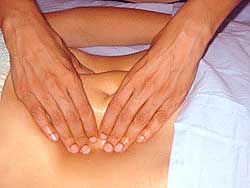 Ayurvedic massage has long been an important part of overall Ayurvedic treatment. The aim of Ayurvedic massage is to prevent build up of toxic substances and restore the balance of energies inside the body. In order to achieve this, the Ayurvedic massage uses a variety of substances like aromatic and medicated oils, powdered foods such as lentil, and various powdered herbs.
The use of these substances varies according to:
- The needs of the patient (his/her constitution)
The ailment ( the imbalance in the doshas) - The type of massage recommended
Requirements
- A Massage should preferably be done in the early hours of the morning, when the stomach is empty. It can also be administered in the evening, 3-4 hours after lunch. However, it should never be done immediately after a meal
- The massage room should be warm and cozy. Massage can be done either on the massage table, which is about the height of one's waist, or it can be on the floor.
- The table should be properly covered with clean white cloth, so that the patient is comfortable during the massage. For other procedures like head massage and oil drip on the head, a special type of table should be used which facilitates recovery of the massage oil from the body of the patient.
- The masseur should be healthy. He should not be suffering from any contagious skin disease and should cut all his nails properly so that during massage they will not harm the patient.
- The oil to be used for massage should be cold during summer and warm during winter.
more info:
Tuesday, December 06, 2005
Balm from the East
The effectiveness of the ancient Indian healing art of ayurveda is getting a closer look in the U.S.
By Jenny Hontz, Special to The Times
Jon Mejia experienced heart palpitations after a particularly stressful period running his Santa Monica consulting firm. His doctor diagnosed an abnormal heart rhythm and sent him to a specialist at a prestigious Los Angeles medical center.
An echocardiogram detected no cause for the extra heartbeats. Although his doctor told him that beta blocker drugs could control the symptoms, Mejia, 49, didn't want to take them because of concerns about side effects.
FOR THE RECORD
Ayurveda — An article in Monday's Health section incorrectly defined a BAMS as a bachelor's in alternative medicine. It is a bachelor's degree in ayurvedic medicine and surgery.
So Mejia turned instead to Martha Soffer and John Holmstrom, practitioners of the ancient Indian medical system ayurveda. After some dietary changes and three days of massage and purification treatments called panchakarma at Surya Spa, an ayurvedic center in Pacific Palisades, "the heart palpitations are almost gone," he says.
"I can't pretend to tell you I know how it works, but if I were to compare where I was when I walked in to where I am now, it's at least 80% relief," Mejia says. "I'm more myself."
Mejia is one of a growing number of Americans taking an interest in ayurveda, a 5,000-year-old holistic system of health that in Sanskrit means "knowledge of life." It uses combinations of herbs, purgatives, rubbing oils and other elements to treat diseases.
Maharishi Mahesh Yogi, a proponent of transcendental meditation, brought ayurveda to the United States three decades ago, and Dr. Deepak Chopra exposed it to the masses in his bestseller "Perfect Health" (Harmony Books, 1991). Now, the California Assn. of Ayurvedic Medicine, a professional group based in Foster City, Calif., is sponsoring its first Ayurveda Awareness Day on Feb. 13.
Chinese medicine, which is more established in the U.S., was influenced by ayurveda, and similarities include the extensive use of natural herbs. Research into ayurveda is in its infancy in this country, but as interest grows, so does funding. The National Institute of Health's National Center for Complementary and Alternative Medicine allocated $3.5 million in grants last year to study its safety and efficacy.
"It's 100 times more popular than it was 10 years ago," says Scott Gerson, a New York physician with a medical degree from the U.S. and a doctorate in ayurveda from India.
*
Yoga's sister science
Ayurveda treatments are becoming popular in spas, medical clinics and wellness centers. And like Mejia, many people are finding their way to ayurvedic medicine through the practice of yoga. Ayurveda is considered yoga's sister science, and workshops are frequently taught in yoga studios throughout Southern California.
"Yoga is the doorway," says Mas Vidal, owner of Dancing Shiva, a Los Angeles Veda yoga studio that added an ayurveda healing center last year. "Ayurveda is what all the great yogis practiced. Ayurveda was taught as a way of life."
Ayurveda holds that health and well-being of the body, mind and spirit is our natural state, experienced through proper diet, herbs, meditation, yoga, breathing exercises called pranayama and other daily routines. Ayurveda is used to prevent disease and boost the immune system so the body can heal itself from illness.
Ayurveda teaches that each person is made up of a combination of five elements: space, air, fire, water and earth, says Dr. Vasant Lad, a prominent Indian-trained physician who is chairman of the Ayurvedic Institute in Albuquerque. These elements combine to create three predominant doshas, or governing principles of the body: vata, pitta and kapha. Each person's constitution is one of these doshas, or a combination of them.
According to ayurvedic practice, vata people tend to be thin; they have cold hands and feet, dry skin and they are more likely to suffer from anxiety, insomnia, arthritis and constipation. Pitta types are "hot," with medium builds and oily skin; they have strong appetites, controlling natures, sharp intellects and quick reactions. They get inflammatory diseases, rashes and ulcers. Kapha types are frequently overweight. They move slowly, love salty and sweet foods, have thick hair and big eyes and are prone to colds, congestion and diabetes, Lad says.
Each of these groups has different dietary and lifestyle needs, which also vary by season. Disease in ayurveda is an imbalance in one's natural doshas, caused by improper diet and digestion, negative emotions and stress, which lead to a buildup of toxins in the body called ama.
Ayurvedic practitioners believe that this needs to be corrected through lifestyle changes, as well as panchakarma treatments, including a special diet, laxatives, herbal oil massages, sweat treatments, herbal enemas, nasal therapies and shirodhara, the pouring of oil onto the forehead for roughly 30 minutes. These treatments are typically performed in certain seasons and continue for three to 10 days.
In India, practices such as vomiting and bloodletting also are used for specific illnesses, but these are rarely done in the U.S. Some practitioners also incorporate sound, color and aromatherapy.
"All tools are at the disposal of ayurveda, but we recognize the tool is not the cure," says Marc Halpern, founder of the California College of Ayurveda in Grass Valley, Calif. "Western medicine controls the symptom. Ayurveda looks at the root causes in terms of lifestyle and consciousness."
Suppressed during British rule in India, ayurveda was preserved by practitioner families and is now taught in Indian medical schools, which require five years of training and clinical experience. The Indian government sponsors numerous scientific studies on ayurveda and its collection of medicinal herbs.
While ayurveda is often used in India by people too poor to receive Western medicine, panchakarma treatments in the U.S. cost $1,500 to $3,500 a week and are mainly the province of the wealthy, devoted or desperate. Holmstrom says he has treated some Hollywood celebrities, including Liv Tyler, Ben Affleck and Matt Damon. Chopra treats people at his Chopra Center at the La Costa Resort and Spa in Carlsbad.
*
Changing attitudes
But ayurveda also is attracting people with chronic health problems who have become frustrated with Western medical techniques that haven't helped them, and those with alcohol and drug problems who want to detox quickly. One Los Angeles lawyer with chronic pain and sleeplessness from damaged spinal disks used ayurveda to kick a growing reliance on sleeping pills and says panchakarma was not about getting pampered.
"By the fifth day, you are enema-ed out…. ," said the lawyer, who asked that her name not be used. "It's not a fun procedure. If you're interested in going to a spa and getting a facial, this is not for you."
Still, the treatments worked so well that she asked her doctor to write a prescription for panchakarma so insurance would cover it. She says his response was something like: "I'm not going to sully my name by prescribing something so weird."
Although ayurveda is still relatively new in Southern California, such attitudes are gradually changing as ayurveda is subjected to the rigors of Western science. It's difficult to conduct double-blind, placebo-controlled trials, the gold standard of scientific research, because ayurveda is a holistic system that treats individuals differently with multiple methods. Some studies have isolated specific components of ayurveda, which advocates of ayurveda say misses the point.
But last fall, the National Center for Complementary and Alternative Medicine awarded a two-year, $283,000 grant to establish an Ayurvedic Center of Collaborative Research to study ayurveda as it is practiced in India. Overseen by researcher Leanna Standish at Bastyr University in Kenmore, Wash., scientists from Johns Hopkins University and UCLA will work with doctors in India to conduct controlled clinical trials on ayurvedic treatments for rheumatoid arthritis. Eventually, they hope to study treatments for hepatitis C, osteoarthritis and diabetes.
"I do not believe there have been any well-done studies of the whole practice of ayurveda…. " overseen by independent U.S. researchers, Standish says. "It really does deserve very careful evaluation."
Although the numbers are still small, more Western doctors are getting trained. Dr. Vandana Soni, an anesthesiologist, realized after years of practicing Western medicine that it only "touches the surface of pain." She now combines Indian and Western medicine at her clinic, and some local medical doctors now refer patients to her for conditions such as irritable bowel syndrome, chronic fatigue and menopausal symptoms.
"If ayurveda were perfect, [Western] allopathic medicine would never have come along," she says. "If allopathic medicine were perfect, the world of alternative medicine wouldn't have come into place."
When you visit an ayurvedic clinic for the first time, prepare to spend a couple of hours. "Ayurveda is very time-intensive," says Dr. Nancy Lonsdorf, medical director at the Raj Ayurveda Health Center in Iowa. "I never see more than 12 patients a day. Most doctors see 50."
At her clinic, Soni asks patients to fill out a 15-page questionnaire detailing everything from the time they wake up to the characteristics of bowel movements. After a pulse-taking and tongue examination, she determines a patient's dosha and prescribes some herbs, spices and self-massage as part of a basic work-up.
Soni recommends patients retain their primary Western doctors, and she won't treat people taking Chinese herbs because of possible side effects.
*
Standards lacking
This is one of the problems with ayurveda in the U.S., where people often ingest a complex stew of drugs and Eastern herbs, whose interactions are poorly understood. Although acupuncturists and doctors of Oriental medicine must be certified and licensed in California and many other states, there are no standards for training or for practicing ayurveda. Because a system for licensing is probably still years away, "it's buyer beware," Holmstrom says.
Gerson advises people to look for a bachelor's degree in alternative medicine, a doctorate or a medical degree in ayurveda from India. He also founded the National Institute of Ayurvedic Medicine, which verifies practitioner credentials. Because the programs teaching ayurveda in the U.S. require just 300 to 500 hours of training, most practitioners here are unqualified to practice in India. Gerson says U.S. schools offer "a really poor level of training in ayurveda."
Although it's hard to imagine someone being harmed by oil massages, Gerson says ayurvedic treatments performed by the unqualified can have "serious consequences," including headaches, bowel dysfunction, irregular respiration, fatigue and psychological problems. Enemas are "invasive" and when performed improperly can cause colon spasms. "The biggest harm that can be done is the withholding of proper treatment," says Wynn Werner, the administrator of the Ayurvedic Institute.
Gerson cites the case of a well-known ayurvedic doctor who treated a woman in her mid-40s complaining of fatigue and muscle aches. "He took her pulse, looked in her eyes and diagnosed a vata imbalance," Gerson said. Prescribing some herbs, dietary changes and yoga, he sent the woman away. A few months later, the family informed him she was diagnosed with leukemia. "Because the ayurvedic doctor did not integrate a blood test," he says, "this was missed." But as long as people are prudent, most ayurvedic lifestyle changes have stress-reducing benefits and little chance of harming one's health, Halpern says.
*
(BEGIN TEXT OF INFOBOX)
What's your dosha type?
Ayurveda sets forth three types of physical, mental and emotional characteristics that are said to be present in everyone. Below are some of the common characteristics of each type. Though all people are said to have qualities of each dosha type, one is usually predominant, according to ayurvedic practice.
Vata
Cold bodies.
Quick minds, creative.
Dry, wrinkled skin.
Walk and talk fast.
Poor planners.
Nervous, anxious.
Susceptible to diseases such as emphysema, pneumonia, arthritis.
Pitta
Warm bodies.
Sharp intellect.
Strong appetite.
Oily skin.
React quickly, easily agitated.
Susceptible to fever, inflammatory diseases.
Kapha
Strong, good stamina.
Sweet, loving disposition.
Calm, tolerant, forgiving.
Dislike exercise.
Susceptible to flu, sinus congestion.
Oily, smooth skin.
To determine your dosha type, go to the National Institute of Ayurvedic Medicine, http://www.niam.com .
Source: The Ayurvedic Institute, Albuquerque
More informations here:
http://www.dreddyclinic.com/ayurvedic/ayurvedic.htm
http://www.dreddyclinic.com/education/education.htm
By Jenny Hontz, Special to The Times
Jon Mejia experienced heart palpitations after a particularly stressful period running his Santa Monica consulting firm. His doctor diagnosed an abnormal heart rhythm and sent him to a specialist at a prestigious Los Angeles medical center.
An echocardiogram detected no cause for the extra heartbeats. Although his doctor told him that beta blocker drugs could control the symptoms, Mejia, 49, didn't want to take them because of concerns about side effects.
FOR THE RECORD
Ayurveda — An article in Monday's Health section incorrectly defined a BAMS as a bachelor's in alternative medicine. It is a bachelor's degree in ayurvedic medicine and surgery.
So Mejia turned instead to Martha Soffer and John Holmstrom, practitioners of the ancient Indian medical system ayurveda. After some dietary changes and three days of massage and purification treatments called panchakarma at Surya Spa, an ayurvedic center in Pacific Palisades, "the heart palpitations are almost gone," he says.
"I can't pretend to tell you I know how it works, but if I were to compare where I was when I walked in to where I am now, it's at least 80% relief," Mejia says. "I'm more myself."
Mejia is one of a growing number of Americans taking an interest in ayurveda, a 5,000-year-old holistic system of health that in Sanskrit means "knowledge of life." It uses combinations of herbs, purgatives, rubbing oils and other elements to treat diseases.
Maharishi Mahesh Yogi, a proponent of transcendental meditation, brought ayurveda to the United States three decades ago, and Dr. Deepak Chopra exposed it to the masses in his bestseller "Perfect Health" (Harmony Books, 1991). Now, the California Assn. of Ayurvedic Medicine, a professional group based in Foster City, Calif., is sponsoring its first Ayurveda Awareness Day on Feb. 13.
Chinese medicine, which is more established in the U.S., was influenced by ayurveda, and similarities include the extensive use of natural herbs. Research into ayurveda is in its infancy in this country, but as interest grows, so does funding. The National Institute of Health's National Center for Complementary and Alternative Medicine allocated $3.5 million in grants last year to study its safety and efficacy.
"It's 100 times more popular than it was 10 years ago," says Scott Gerson, a New York physician with a medical degree from the U.S. and a doctorate in ayurveda from India.
*
Yoga's sister science
Ayurveda treatments are becoming popular in spas, medical clinics and wellness centers. And like Mejia, many people are finding their way to ayurvedic medicine through the practice of yoga. Ayurveda is considered yoga's sister science, and workshops are frequently taught in yoga studios throughout Southern California.
"Yoga is the doorway," says Mas Vidal, owner of Dancing Shiva, a Los Angeles Veda yoga studio that added an ayurveda healing center last year. "Ayurveda is what all the great yogis practiced. Ayurveda was taught as a way of life."
Ayurveda holds that health and well-being of the body, mind and spirit is our natural state, experienced through proper diet, herbs, meditation, yoga, breathing exercises called pranayama and other daily routines. Ayurveda is used to prevent disease and boost the immune system so the body can heal itself from illness.
Ayurveda teaches that each person is made up of a combination of five elements: space, air, fire, water and earth, says Dr. Vasant Lad, a prominent Indian-trained physician who is chairman of the Ayurvedic Institute in Albuquerque. These elements combine to create three predominant doshas, or governing principles of the body: vata, pitta and kapha. Each person's constitution is one of these doshas, or a combination of them.
According to ayurvedic practice, vata people tend to be thin; they have cold hands and feet, dry skin and they are more likely to suffer from anxiety, insomnia, arthritis and constipation. Pitta types are "hot," with medium builds and oily skin; they have strong appetites, controlling natures, sharp intellects and quick reactions. They get inflammatory diseases, rashes and ulcers. Kapha types are frequently overweight. They move slowly, love salty and sweet foods, have thick hair and big eyes and are prone to colds, congestion and diabetes, Lad says.
Each of these groups has different dietary and lifestyle needs, which also vary by season. Disease in ayurveda is an imbalance in one's natural doshas, caused by improper diet and digestion, negative emotions and stress, which lead to a buildup of toxins in the body called ama.
Ayurvedic practitioners believe that this needs to be corrected through lifestyle changes, as well as panchakarma treatments, including a special diet, laxatives, herbal oil massages, sweat treatments, herbal enemas, nasal therapies and shirodhara, the pouring of oil onto the forehead for roughly 30 minutes. These treatments are typically performed in certain seasons and continue for three to 10 days.
In India, practices such as vomiting and bloodletting also are used for specific illnesses, but these are rarely done in the U.S. Some practitioners also incorporate sound, color and aromatherapy.
"All tools are at the disposal of ayurveda, but we recognize the tool is not the cure," says Marc Halpern, founder of the California College of Ayurveda in Grass Valley, Calif. "Western medicine controls the symptom. Ayurveda looks at the root causes in terms of lifestyle and consciousness."
Suppressed during British rule in India, ayurveda was preserved by practitioner families and is now taught in Indian medical schools, which require five years of training and clinical experience. The Indian government sponsors numerous scientific studies on ayurveda and its collection of medicinal herbs.
While ayurveda is often used in India by people too poor to receive Western medicine, panchakarma treatments in the U.S. cost $1,500 to $3,500 a week and are mainly the province of the wealthy, devoted or desperate. Holmstrom says he has treated some Hollywood celebrities, including Liv Tyler, Ben Affleck and Matt Damon. Chopra treats people at his Chopra Center at the La Costa Resort and Spa in Carlsbad.
*
Changing attitudes
But ayurveda also is attracting people with chronic health problems who have become frustrated with Western medical techniques that haven't helped them, and those with alcohol and drug problems who want to detox quickly. One Los Angeles lawyer with chronic pain and sleeplessness from damaged spinal disks used ayurveda to kick a growing reliance on sleeping pills and says panchakarma was not about getting pampered.
"By the fifth day, you are enema-ed out…. ," said the lawyer, who asked that her name not be used. "It's not a fun procedure. If you're interested in going to a spa and getting a facial, this is not for you."
Still, the treatments worked so well that she asked her doctor to write a prescription for panchakarma so insurance would cover it. She says his response was something like: "I'm not going to sully my name by prescribing something so weird."
Although ayurveda is still relatively new in Southern California, such attitudes are gradually changing as ayurveda is subjected to the rigors of Western science. It's difficult to conduct double-blind, placebo-controlled trials, the gold standard of scientific research, because ayurveda is a holistic system that treats individuals differently with multiple methods. Some studies have isolated specific components of ayurveda, which advocates of ayurveda say misses the point.
But last fall, the National Center for Complementary and Alternative Medicine awarded a two-year, $283,000 grant to establish an Ayurvedic Center of Collaborative Research to study ayurveda as it is practiced in India. Overseen by researcher Leanna Standish at Bastyr University in Kenmore, Wash., scientists from Johns Hopkins University and UCLA will work with doctors in India to conduct controlled clinical trials on ayurvedic treatments for rheumatoid arthritis. Eventually, they hope to study treatments for hepatitis C, osteoarthritis and diabetes.
"I do not believe there have been any well-done studies of the whole practice of ayurveda…. " overseen by independent U.S. researchers, Standish says. "It really does deserve very careful evaluation."
Although the numbers are still small, more Western doctors are getting trained. Dr. Vandana Soni, an anesthesiologist, realized after years of practicing Western medicine that it only "touches the surface of pain." She now combines Indian and Western medicine at her clinic, and some local medical doctors now refer patients to her for conditions such as irritable bowel syndrome, chronic fatigue and menopausal symptoms.
"If ayurveda were perfect, [Western] allopathic medicine would never have come along," she says. "If allopathic medicine were perfect, the world of alternative medicine wouldn't have come into place."
When you visit an ayurvedic clinic for the first time, prepare to spend a couple of hours. "Ayurveda is very time-intensive," says Dr. Nancy Lonsdorf, medical director at the Raj Ayurveda Health Center in Iowa. "I never see more than 12 patients a day. Most doctors see 50."
At her clinic, Soni asks patients to fill out a 15-page questionnaire detailing everything from the time they wake up to the characteristics of bowel movements. After a pulse-taking and tongue examination, she determines a patient's dosha and prescribes some herbs, spices and self-massage as part of a basic work-up.
Soni recommends patients retain their primary Western doctors, and she won't treat people taking Chinese herbs because of possible side effects.
*
Standards lacking
This is one of the problems with ayurveda in the U.S., where people often ingest a complex stew of drugs and Eastern herbs, whose interactions are poorly understood. Although acupuncturists and doctors of Oriental medicine must be certified and licensed in California and many other states, there are no standards for training or for practicing ayurveda. Because a system for licensing is probably still years away, "it's buyer beware," Holmstrom says.
Gerson advises people to look for a bachelor's degree in alternative medicine, a doctorate or a medical degree in ayurveda from India. He also founded the National Institute of Ayurvedic Medicine, which verifies practitioner credentials. Because the programs teaching ayurveda in the U.S. require just 300 to 500 hours of training, most practitioners here are unqualified to practice in India. Gerson says U.S. schools offer "a really poor level of training in ayurveda."
Although it's hard to imagine someone being harmed by oil massages, Gerson says ayurvedic treatments performed by the unqualified can have "serious consequences," including headaches, bowel dysfunction, irregular respiration, fatigue and psychological problems. Enemas are "invasive" and when performed improperly can cause colon spasms. "The biggest harm that can be done is the withholding of proper treatment," says Wynn Werner, the administrator of the Ayurvedic Institute.
Gerson cites the case of a well-known ayurvedic doctor who treated a woman in her mid-40s complaining of fatigue and muscle aches. "He took her pulse, looked in her eyes and diagnosed a vata imbalance," Gerson said. Prescribing some herbs, dietary changes and yoga, he sent the woman away. A few months later, the family informed him she was diagnosed with leukemia. "Because the ayurvedic doctor did not integrate a blood test," he says, "this was missed." But as long as people are prudent, most ayurvedic lifestyle changes have stress-reducing benefits and little chance of harming one's health, Halpern says.
*
(BEGIN TEXT OF INFOBOX)
What's your dosha type?
Ayurveda sets forth three types of physical, mental and emotional characteristics that are said to be present in everyone. Below are some of the common characteristics of each type. Though all people are said to have qualities of each dosha type, one is usually predominant, according to ayurvedic practice.
Vata
Cold bodies.
Quick minds, creative.
Dry, wrinkled skin.
Walk and talk fast.
Poor planners.
Nervous, anxious.
Susceptible to diseases such as emphysema, pneumonia, arthritis.
Pitta
Warm bodies.
Sharp intellect.
Strong appetite.
Oily skin.
React quickly, easily agitated.
Susceptible to fever, inflammatory diseases.
Kapha
Strong, good stamina.
Sweet, loving disposition.
Calm, tolerant, forgiving.
Dislike exercise.
Susceptible to flu, sinus congestion.
Oily, smooth skin.
To determine your dosha type, go to the National Institute of Ayurvedic Medicine, http://www.niam.com .
Source: The Ayurvedic Institute, Albuquerque
More informations here:
http://www.dreddyclinic.com/ayurvedic/ayurvedic.htm
http://www.dreddyclinic.com/education/education.htm
Are Your Personal and Skin Care Products Safe?
ABC announced a study that was recently conducted on 72 name brand products. Of these 72 products, 52 contained at least one kind of phthalate. What is even more perplexing is that only 1 of the products tested lists it as an ingredient on the label - another cosmetic conspiracy! Did you know that studies conducted on animals show that phthalates can damage the liver, kidneys, lungs, and reproductive system?
According to Ayurveda, you should put on your skin only products that are completely natural and chemically free. 100x washed ghruta Cream is made from an organic ghee that is used for gourmet cooking. This ghruta is washed 100 times in a copper bowl while reciting mantras. This process completely transforms the ghruta into cooling, nourishing, silky cream.
100x washed ghruta Cream is very well absorbed by the skin and leaves the skin feeling refreshed, rejuvenated, and glowing.
It is an excellent Astringent, Moisturiser, Anti-wrinkle & Cleansing cream. Can be used as a daily moisturizer on the face (or whole body) or for facial massage. Also, has calming effect on reddish or burned skin, and on eczema and rosacea.
According to Ayurveda, you should put on your skin only products that are completely natural and chemically free. 100x washed ghruta Cream is made from an organic ghee that is used for gourmet cooking. This ghruta is washed 100 times in a copper bowl while reciting mantras. This process completely transforms the ghruta into cooling, nourishing, silky cream.
100x washed ghruta Cream is very well absorbed by the skin and leaves the skin feeling refreshed, rejuvenated, and glowing.
It is an excellent Astringent, Moisturiser, Anti-wrinkle & Cleansing cream. Can be used as a daily moisturizer on the face (or whole body) or for facial massage. Also, has calming effect on reddish or burned skin, and on eczema and rosacea.
Subscribe to:
Posts (Atom)
Kamarani

