If you're ready to expand your family, you may need a little help (outside of the bedroom, of course!)
Showing posts with label baby. Show all posts
Showing posts with label baby. Show all posts
Wednesday, August 13, 2008


Thursday, August 07, 2008
Quiz: What Fragrance Is Perfect for Your Type?
Adapted from What’s Your Dosha, Baby? by Lisa Marie Coffey (Marlowe and Company, 2004).
Here is a great tool to try when you’re feeling unbalanced: first, take the fun quiz to determine your dosha, or life-energy type, then see which fragrances will help you to stay calm and energized, serene and stable. The answers may surprise you, but they are based on a potent combination of ancient Hindu Ayurvedic wisdom and aromatherapy science. Continue Reading >>
Also Visit Our Websites for:
Beauty
Brain Power
Cat Health
Detoxification
Cold & Flu
Dog Health
Female Arousal
Healthy Blood
Heart Care
Immune Support
Joint Care
Lover's Yoga
Male Virility
Mood Support
Natural Healing
PMS Relief
Prostate Care
Sleep Aid
Strength
Weight Loss
Here is a great tool to try when you’re feeling unbalanced: first, take the fun quiz to determine your dosha, or life-energy type, then see which fragrances will help you to stay calm and energized, serene and stable. The answers may surprise you, but they are based on a potent combination of ancient Hindu Ayurvedic wisdom and aromatherapy science. Continue Reading >>
Also Visit Our Websites for:
Beauty
Brain Power
Cat Health
Detoxification
Cold & Flu
Dog Health
Female Arousal
Healthy Blood
Heart Care
Immune Support
Joint Care
Lover's Yoga
Male Virility
Mood Support
Natural Healing
PMS Relief
Prostate Care
Sleep Aid
Strength
Weight Loss
Thursday, December 20, 2007
Standard Hepatitis B Treatment Bested by Newcomer
(HealthDay News) -- New research suggests that a newer medication approved for treating hepatitis B is more effective than the standard treatment, lamivudine.
Additionally, the Chinese scientists found that a significantly smaller number of people developed resistance to the newer drug, known as telbivudine (Tyzeka, Sebivo).
The study, which is published in the Dec. 20 issue of the New England Journal of Medicine, found that about 8 percent more people responded to telbivudine than lamivudine, and the risk of resistance was at least halved for people taking telbivudine.
"The multiple therapeutic choices now available for hepatitis B will enhance the ability of clinicians to maintain long-term control of HBV replication, ultimately improving clinical outcomes for more patients. These results support telbivudine as an effective therapy for patients with chronic hepatitis B," the study authors wrote.
Hepatitis B is a viral infection that attacks the liver. It can be spread in many ways, including through the exchange of blood and other bodily fluids when having sex, from sharing needles, or from a mother to her baby during pregnancy, according to the U.S. Centers for Disease Control and Prevention.
As many as one third of people infected have no symptoms, according to the CDC. When symptoms do occur, they may include jaundice, fatigue, abdominal pain, loss of appetite, nausea, vomiting and joint pain. For most people, the infection is transient, lasting no more than six months or so. However, the infection can become chronic. This occurs in only about 6 percent of people over 5 who are infected with the hepatitis B virus, in about 30 percent of infected children between 1 and 5 years old, and in as many as 90 percent of babies who are infected with the virus. Chronic hepatitis B can cause scarring of the liver, which can lead to liver cancer or liver failure.
The goal of treatment is to keep levels of the hepatitis B virus as low as possible. Even if hepatitis B levels become so low that they're undetectable, long-term treatment is still required to prevent recurrence. People with hepatitis B are tested to see if they are positive or negative for E-antigens. A positive result on the E-antigen test often indicates a stronger infection, according to the Hepatitis B Foundation. Someone with a positive result is referred to as HBeAg-positive.
While there are several treatment options available to suppress the virus, one problem is that people can develop resistance to these drugs. Two new drugs, entecavir (Baraclude) and telbivudine, have been approved to treat hepatitis B since 2005.
The current study looked at how effective telbivudine is compared to the standard first-line treatment, lamivudine.
The researchers randomly assigned 1,370 people with chronic hepatitis B to receive either 600 milligrams of telbivudine or 100 milligrams of lamivudine once daily.
After a year of treatment, 75.3 percent of HBeAg-positive people taking telbivudine showed a therapeutic response versus 67 percent of those on lamivudine. In HBeAg-negative people, 64.7 percent of those on telbivudine had a response compared to 56.3 percent of those on lamivudine.
The number of study volunteers who had undetectable levels of hepatitis B virus by the end of the treatment year were much greater for those on telbivudine. In HBeAg-positive people, 60 percent achieved undetectable levels on telbivudine versus 40.4 percent for those taking lamivudine. For HBeAg-negative study participants, telbivudine brought viral levels down to undetectable for 88.3 percent compared to 71.4 percent for lamivudine. Telbivudine also got those viral levels down about five to six weeks faster, on average, than lamivudine.
Resistance developed in 5 percent of HBeAg-positive people taking telbivudine and in 11 percent of those on lamivudine. For those who were HBeAg-negative, the rates of resistance were 2.3 percent for those on telbivudine and 10.7 percent for those on lamivudine.
According to the study's authors, both medications have a similar side effect profile, and no significant differences were found in the current study volunteers.
"Telbivudine seems to work and be safe. It seems to have shown a better therapeutic and histological response," said Dr. Marc Siegel, an internist at New York University Medical Center.
"It decreases the risk of cirrhosis. It's well-tolerated, and it prevents the progression of hepatitis B better than the standard treatment right now," said Siegel.
The study authors pointed out that telbivudine hasn't yet been compared to the other new hepatitis B medication, entecavir, in a randomized clinical trial. Entecavir has also been shown to be more effective than lamivudine and creates less resistance as well.
More information
To learn more about available treatments for hepatitis B, visit the Hepatitis B Foundation.
Additionally, the Chinese scientists found that a significantly smaller number of people developed resistance to the newer drug, known as telbivudine (Tyzeka, Sebivo).
The study, which is published in the Dec. 20 issue of the New England Journal of Medicine, found that about 8 percent more people responded to telbivudine than lamivudine, and the risk of resistance was at least halved for people taking telbivudine.
"The multiple therapeutic choices now available for hepatitis B will enhance the ability of clinicians to maintain long-term control of HBV replication, ultimately improving clinical outcomes for more patients. These results support telbivudine as an effective therapy for patients with chronic hepatitis B," the study authors wrote.
Hepatitis B is a viral infection that attacks the liver. It can be spread in many ways, including through the exchange of blood and other bodily fluids when having sex, from sharing needles, or from a mother to her baby during pregnancy, according to the U.S. Centers for Disease Control and Prevention.
As many as one third of people infected have no symptoms, according to the CDC. When symptoms do occur, they may include jaundice, fatigue, abdominal pain, loss of appetite, nausea, vomiting and joint pain. For most people, the infection is transient, lasting no more than six months or so. However, the infection can become chronic. This occurs in only about 6 percent of people over 5 who are infected with the hepatitis B virus, in about 30 percent of infected children between 1 and 5 years old, and in as many as 90 percent of babies who are infected with the virus. Chronic hepatitis B can cause scarring of the liver, which can lead to liver cancer or liver failure.
The goal of treatment is to keep levels of the hepatitis B virus as low as possible. Even if hepatitis B levels become so low that they're undetectable, long-term treatment is still required to prevent recurrence. People with hepatitis B are tested to see if they are positive or negative for E-antigens. A positive result on the E-antigen test often indicates a stronger infection, according to the Hepatitis B Foundation. Someone with a positive result is referred to as HBeAg-positive.
While there are several treatment options available to suppress the virus, one problem is that people can develop resistance to these drugs. Two new drugs, entecavir (Baraclude) and telbivudine, have been approved to treat hepatitis B since 2005.
The current study looked at how effective telbivudine is compared to the standard first-line treatment, lamivudine.
The researchers randomly assigned 1,370 people with chronic hepatitis B to receive either 600 milligrams of telbivudine or 100 milligrams of lamivudine once daily.
After a year of treatment, 75.3 percent of HBeAg-positive people taking telbivudine showed a therapeutic response versus 67 percent of those on lamivudine. In HBeAg-negative people, 64.7 percent of those on telbivudine had a response compared to 56.3 percent of those on lamivudine.
The number of study volunteers who had undetectable levels of hepatitis B virus by the end of the treatment year were much greater for those on telbivudine. In HBeAg-positive people, 60 percent achieved undetectable levels on telbivudine versus 40.4 percent for those taking lamivudine. For HBeAg-negative study participants, telbivudine brought viral levels down to undetectable for 88.3 percent compared to 71.4 percent for lamivudine. Telbivudine also got those viral levels down about five to six weeks faster, on average, than lamivudine.
Resistance developed in 5 percent of HBeAg-positive people taking telbivudine and in 11 percent of those on lamivudine. For those who were HBeAg-negative, the rates of resistance were 2.3 percent for those on telbivudine and 10.7 percent for those on lamivudine.
According to the study's authors, both medications have a similar side effect profile, and no significant differences were found in the current study volunteers.
"Telbivudine seems to work and be safe. It seems to have shown a better therapeutic and histological response," said Dr. Marc Siegel, an internist at New York University Medical Center.
"It decreases the risk of cirrhosis. It's well-tolerated, and it prevents the progression of hepatitis B better than the standard treatment right now," said Siegel.
The study authors pointed out that telbivudine hasn't yet been compared to the other new hepatitis B medication, entecavir, in a randomized clinical trial. Entecavir has also been shown to be more effective than lamivudine and creates less resistance as well.
More information
To learn more about available treatments for hepatitis B, visit the Hepatitis B Foundation.
Monday, November 05, 2007
Urinary Tract Infection May Raise Birth Defect Risk
(HealthDay News) -- Pregnant women who had a urinary tract infection (UTI) from one month before conception through the first trimester of pregnancy were 70 percent more likely than women without UTI to have a baby with a defect called hypoplastic left heart syndrome (underdeveloped left side of the heart), a U.S. study finds.
This association was independent of other factors, such as vitamin use, folic acid intake, alcohol consumption, race, ethnicity, mother's age, or exposure to sulfonamide ("sulfa") drugs, said the researchers.
The National Birth Defects Prevention Study included 3,690 women who had infants with "nonsyndromic" congenital birth defects and 4,760 mothers of babies without birth defects.
Detecting and treating asymptomatic bacteriuria and UTI in women at time of conception "may decrease the risk of having an infant with a left-sided obstructive cardiac defect," study author Sadia Malik, of the University of Arkansas Medical School in Little Rock, said in a prepared statement.
The study was expected to be presented Sunday at the American Heart Association annual meeting in Orlando, Fla.
More information
The American Heart Association has more about hypoplastic left heart syndrome.
This association was independent of other factors, such as vitamin use, folic acid intake, alcohol consumption, race, ethnicity, mother's age, or exposure to sulfonamide ("sulfa") drugs, said the researchers.
The National Birth Defects Prevention Study included 3,690 women who had infants with "nonsyndromic" congenital birth defects and 4,760 mothers of babies without birth defects.
Detecting and treating asymptomatic bacteriuria and UTI in women at time of conception "may decrease the risk of having an infant with a left-sided obstructive cardiac defect," study author Sadia Malik, of the University of Arkansas Medical School in Little Rock, said in a prepared statement.
The study was expected to be presented Sunday at the American Heart Association annual meeting in Orlando, Fla.
More information
The American Heart Association has more about hypoplastic left heart syndrome.
Sunday, September 30, 2007
Health Tip: Even Babies Can Have Foot Problems
(HealthDay News) -- New parents are understandably concerned about the health of their baby. But while worrying about hearing, eyesight and other things, they might forget the feet.
The American Podiatric Medical Association warns that foot problems that flare up in adults often start in infancy.
The association says parents should report anything suspicious to the family doctor. To maintain healthy feet, parents should make sure blankets are loose and allow the baby to kick. Also, be sure to change the baby's position often because lying too long in one position can strain the legs and feet.
The American Podiatric Medical Association warns that foot problems that flare up in adults often start in infancy.
The association says parents should report anything suspicious to the family doctor. To maintain healthy feet, parents should make sure blankets are loose and allow the baby to kick. Also, be sure to change the baby's position often because lying too long in one position can strain the legs and feet.
Thursday, July 26, 2007
Steroids Won't Help Common Respiratory Infection in Infants
(HealthDay News) -- A commonly prescribed steroid called dexamethasone is no more effective in infants with the lower respiratory tract infection bronchiolitis than a placebo, new research suggests.
The study found no statistically significant differences in the rates of hospitalization and in measures of respiratory health between a group of infants given dexamethasone, which can incur side effects, and a group given a placebo.
"For young infants with bronchiolitis with first-time wheezing, we'd hope that the results of this study would lead physicians not to use corticosteroids," said the study's lead author, Dr. Nathan Kuppermann, chairman of the department of emergency medicine at the University of California, Davis. "Why incur the risk of side effects if the medication isn't effective?"
Results of the study are published in the July 26 issue of the New England Journal of Medicine.
Kuppermann was quick to point out that this study's findings do not mean that corticosteroids don't have a place in the treatment of other airway diseases. For example, corticosteroids are an often-used and effective treatment for asthma.
Bronchiolitis is a common respiratory infection in children and is the leading cause of hospitalizations for infants in the United States. Each year, as many as 100,000 infants are hospitalized due to bronchiolitis, according to the study. There are numerous causes of bronchiolitis, and one of the most common is infection with respiratory syncytial virus (RSV).
Treatment options for bronchiolitis are few, and the most common care provided by doctors or hospitals is supportive care, such as extra oxygen. Because corticosteroids are an effective treatment for other respiratory diseases, doctors have used these drugs to treat bronchiolitis as well, although past research hasn't provided clear evidence that they work.
To answer the question of whether or not dexamethasone is helpful for bronchiolitis in the youngest patients, Kuppermann and his colleagues from the Pediatric Emergency Care Applied Research Network conducted a double-blind, randomized study that included 600 children between the ages of 2 and 12 months.
Half of the children were given a single dose of oral dexamethasone (1 milligram per kilogram of body weight), and half of the children received an oral placebo.
Forty percent of babies on dexamethasone had to be hospitalized, compared to 41 percent of those on the placebo. Both groups also saw similar improvements in breathing. And, there was no difference in later outcomes, the study found.
"If a young infant between 2 and 12 months of age presents to the emergency department with first-time wheezing in the wintertime, I would argue that it would be safer not to give steroids than to give them," Kupperman said.
"Sometimes it's just as important to identify medications that aren't effective as it is to identify those that are. We don't want to subject anyone, particularly infants, to unnecessary risks," said Kuppermann.
However, Kuppermann acknowledged that in real-life practice, physicians may still use corticosteroids because there are no reliable alternatives to treat bronchiolitis, and because it can sometimes be difficult to tell in infants whether wheezing is caused by bronchiolitis or asthma.
"These are tiny babies, wheezing and huffing. Can the physician do nothing? The majority of babies do get treatment, despite the fact that these treatments don't appear to be of value," said Dr. Caroline Hall, an infectious-disease specialist at the University of Rochester School of Medicine and Dentistry in New York, and the author of an accompanying editorial in the journal.
"But, we wouldn't want to give something that as far as we know has no effect, because there's always a potential for side effects. No specific drug has been shown to help in bronchiolitis," said Hall, who added, "The best therapy that we know is good supportive, clinical care."
And, Kuppermann pointed out that despite a lack of effective treatments, most babies with bronchiolitis do well and will get better on their own.
More information
To learn more about bronchiolitis, visit the Nemours Foundation.
The study found no statistically significant differences in the rates of hospitalization and in measures of respiratory health between a group of infants given dexamethasone, which can incur side effects, and a group given a placebo.
"For young infants with bronchiolitis with first-time wheezing, we'd hope that the results of this study would lead physicians not to use corticosteroids," said the study's lead author, Dr. Nathan Kuppermann, chairman of the department of emergency medicine at the University of California, Davis. "Why incur the risk of side effects if the medication isn't effective?"
Results of the study are published in the July 26 issue of the New England Journal of Medicine.
Kuppermann was quick to point out that this study's findings do not mean that corticosteroids don't have a place in the treatment of other airway diseases. For example, corticosteroids are an often-used and effective treatment for asthma.
Bronchiolitis is a common respiratory infection in children and is the leading cause of hospitalizations for infants in the United States. Each year, as many as 100,000 infants are hospitalized due to bronchiolitis, according to the study. There are numerous causes of bronchiolitis, and one of the most common is infection with respiratory syncytial virus (RSV).
Treatment options for bronchiolitis are few, and the most common care provided by doctors or hospitals is supportive care, such as extra oxygen. Because corticosteroids are an effective treatment for other respiratory diseases, doctors have used these drugs to treat bronchiolitis as well, although past research hasn't provided clear evidence that they work.
To answer the question of whether or not dexamethasone is helpful for bronchiolitis in the youngest patients, Kuppermann and his colleagues from the Pediatric Emergency Care Applied Research Network conducted a double-blind, randomized study that included 600 children between the ages of 2 and 12 months.
Half of the children were given a single dose of oral dexamethasone (1 milligram per kilogram of body weight), and half of the children received an oral placebo.
Forty percent of babies on dexamethasone had to be hospitalized, compared to 41 percent of those on the placebo. Both groups also saw similar improvements in breathing. And, there was no difference in later outcomes, the study found.
"If a young infant between 2 and 12 months of age presents to the emergency department with first-time wheezing in the wintertime, I would argue that it would be safer not to give steroids than to give them," Kupperman said.
"Sometimes it's just as important to identify medications that aren't effective as it is to identify those that are. We don't want to subject anyone, particularly infants, to unnecessary risks," said Kuppermann.
However, Kuppermann acknowledged that in real-life practice, physicians may still use corticosteroids because there are no reliable alternatives to treat bronchiolitis, and because it can sometimes be difficult to tell in infants whether wheezing is caused by bronchiolitis or asthma.
"These are tiny babies, wheezing and huffing. Can the physician do nothing? The majority of babies do get treatment, despite the fact that these treatments don't appear to be of value," said Dr. Caroline Hall, an infectious-disease specialist at the University of Rochester School of Medicine and Dentistry in New York, and the author of an accompanying editorial in the journal.
"But, we wouldn't want to give something that as far as we know has no effect, because there's always a potential for side effects. No specific drug has been shown to help in bronchiolitis," said Hall, who added, "The best therapy that we know is good supportive, clinical care."
And, Kuppermann pointed out that despite a lack of effective treatments, most babies with bronchiolitis do well and will get better on their own.
More information
To learn more about bronchiolitis, visit the Nemours Foundation.
Sunday, February 04, 2007
Nitroglycerin Could Help Prevent Preterm Births
(HealthDay News) -- Giving nitroglycerin to women in preterm labor helps prolong their pregnancy and improves the health of their babies, Canadian researchers report.
The boost in newborns' health was greatest in those who were born very prematurely (24 weeks to 28 weeks), the study said.
Premature delivery is the leading cause of death and disability of newborns worldwide. According to the researchers at Queen's University in Kingston, Ontario, this is the first study to identify a drug that stops preterm labor and also improves infant outcomes. They said nitroglycerin causes fewer side effects than other drugs.
Published in the January issue of the American Journal of Obstetrics and Gynecology, the five-year study included 153 women who were recruited at the time they went into preterm labor.
Caring for premature babies and their medical complications can be costly for families and societies. Based on their findings, the researchers said that "treatment with nitroglycerin may result in major cost savings and longer-term health benefits for these babies."
The study was funded by the Canadian Institutes of Health Research.
More information
The U.S. National Institute of Child Health and Human Development has more about research into preterm labor and premature birth.
The boost in newborns' health was greatest in those who were born very prematurely (24 weeks to 28 weeks), the study said.
Premature delivery is the leading cause of death and disability of newborns worldwide. According to the researchers at Queen's University in Kingston, Ontario, this is the first study to identify a drug that stops preterm labor and also improves infant outcomes. They said nitroglycerin causes fewer side effects than other drugs.
Published in the January issue of the American Journal of Obstetrics and Gynecology, the five-year study included 153 women who were recruited at the time they went into preterm labor.
Caring for premature babies and their medical complications can be costly for families and societies. Based on their findings, the researchers said that "treatment with nitroglycerin may result in major cost savings and longer-term health benefits for these babies."
The study was funded by the Canadian Institutes of Health Research.
More information
The U.S. National Institute of Child Health and Human Development has more about research into preterm labor and premature birth.
Thursday, August 17, 2006
More Money Equals Less Disability: Study
WEDNESDAY, Aug. 16 (HealthDay News) -- Even a little extra income can make a big difference in helping middle-class people ward off disability, a new study finds.
"The surprise was at the upper end," said Meredith Minkler, an author of a report on the study in the Aug. 17 issue of the New England Journal of Medicine. "We always knew there was a major gap between the very poor and the very rich. To find that the middle class was at a substantial disadvantage to slightly wealthier folks was a surprise."
The study was sponsored by the U.S. National Institute on Aging (NIA), which requires the information to help it prepare for the health needs of aging baby boomers -- 8,000 of them per day -- who are now reaching the age of 60.
The study used data on 335,000 people 55 and older collected as part of the Census 2000 American Community Survey. In that survey, pollsters asked older Americans about disabilities that affected basic activities such as walking, reaching and lifting.
Respondents were classified into nine household income levels, starting with poverty ($8,259 for someone 65 or older living alone in 2000, $17,761 for a family of four) and going up to 700 percent of that figure -- $124,327 or over.
As expected, disability increased with age. While 16.2 percent of men aged 55 to 64 reported disability, the incidence for men 85 and older was 47.5 percent. Among women aged 55 to 64, the incidence of disability was 17.2 percent, compared to 57.9 percent for those aged 85 and older.
The difference between making a good income and making a very good income turned out to be important, the researchers said. For example, men aged 65 to 74 in the "600-699 percent" income group ($49,544 single-person income) had a 44 percent higher odds of disability than those in the "700 percent" group, where single-person income topped $57,813 per year. For women aged 55 to 64, that income difference translated to a 16 percent greater incidence of disability.
There are several possible explanations for the income-linked differences, said Dr. Jack Guralnik, chief of the NIA laboratory of epidemiology, demography and biometry, and a member of the research team.
"Health behaviors explain some of this," Guralnik said. "Also, people with lower incomes tend to have less access to medical care."
But, Guralnik said, "There's something going on here that is not easy to understand, something related to what is going on in life at lower income levels."
The NIA will continue to look at differences in disability, he said. "Better understanding of why income status has an impact on health can lead to better interventions," Guralnik noted.
"One of the things we can conjecture is that people who are upper class have slightly better medical care, a better environment in which to live and fewer hassles," said Minkler, a professor of health and social behavior at the University of California at Berkeley School of Public Health.
Money can also help reduce disability though improvements in the home, she said. "You can widen doorways and put in ramps," Minkler said. "Ultimately, that can make the difference between living at home and being in an institution."
While the United States has "the best-educated, best cared-for population in the history of the world," she said, an increase in disability is inevitable as the number of older people increases. "It's important to find out whether slight increments in income make a difference," Minkler said.
More information
A resource guide for people with disabilities is available from the University of Buffalo.
"The surprise was at the upper end," said Meredith Minkler, an author of a report on the study in the Aug. 17 issue of the New England Journal of Medicine. "We always knew there was a major gap between the very poor and the very rich. To find that the middle class was at a substantial disadvantage to slightly wealthier folks was a surprise."
The study was sponsored by the U.S. National Institute on Aging (NIA), which requires the information to help it prepare for the health needs of aging baby boomers -- 8,000 of them per day -- who are now reaching the age of 60.
The study used data on 335,000 people 55 and older collected as part of the Census 2000 American Community Survey. In that survey, pollsters asked older Americans about disabilities that affected basic activities such as walking, reaching and lifting.
Respondents were classified into nine household income levels, starting with poverty ($8,259 for someone 65 or older living alone in 2000, $17,761 for a family of four) and going up to 700 percent of that figure -- $124,327 or over.
As expected, disability increased with age. While 16.2 percent of men aged 55 to 64 reported disability, the incidence for men 85 and older was 47.5 percent. Among women aged 55 to 64, the incidence of disability was 17.2 percent, compared to 57.9 percent for those aged 85 and older.
The difference between making a good income and making a very good income turned out to be important, the researchers said. For example, men aged 65 to 74 in the "600-699 percent" income group ($49,544 single-person income) had a 44 percent higher odds of disability than those in the "700 percent" group, where single-person income topped $57,813 per year. For women aged 55 to 64, that income difference translated to a 16 percent greater incidence of disability.
There are several possible explanations for the income-linked differences, said Dr. Jack Guralnik, chief of the NIA laboratory of epidemiology, demography and biometry, and a member of the research team.
"Health behaviors explain some of this," Guralnik said. "Also, people with lower incomes tend to have less access to medical care."
But, Guralnik said, "There's something going on here that is not easy to understand, something related to what is going on in life at lower income levels."
The NIA will continue to look at differences in disability, he said. "Better understanding of why income status has an impact on health can lead to better interventions," Guralnik noted.
"One of the things we can conjecture is that people who are upper class have slightly better medical care, a better environment in which to live and fewer hassles," said Minkler, a professor of health and social behavior at the University of California at Berkeley School of Public Health.
Money can also help reduce disability though improvements in the home, she said. "You can widen doorways and put in ramps," Minkler said. "Ultimately, that can make the difference between living at home and being in an institution."
While the United States has "the best-educated, best cared-for population in the history of the world," she said, an increase in disability is inevitable as the number of older people increases. "It's important to find out whether slight increments in income make a difference," Minkler said.
More information
A resource guide for people with disabilities is available from the University of Buffalo.
Tuesday, August 08, 2006
Postpartum Depression Hits Dads, Too
MONDAY, Aug. 7 (HealthDay News) -- Almost as many new fathers as mothers suffer depression after the birth of a child, a new study shows.
About 14 percent of mothers and 10 percent of fathers showed signs of moderate or severe postpartum depression, according to the study, which followed more than 5,000 members of two-parent families.
"There have been a few small studies in the last two years showing this, but nothing has been known on a national basis," said study leader James F. Paulson, an assistant professor of pediatrics and psychology and behavioral sciences at the Eastern Virginia Medical School Center for Pediatric Research.
The findings are published in the August issue of Pediatrics.
New parents who participated in the study filled out questionnaires and were interviewed to determine whether they showed symptoms of depression. Their relationships with their children were determined by questioning such practices as breast-feeding, putting the child to bed on his or her back, and whether the parents read to, played peek-a-boo with or sang to the child.
"What we found in this study is that basic day-to-day interactions were impaired in fathers, just as they were in mothers," Paulson said. "Also, basic activities were impaired."
Pediatricians should make a greater effort to identify postpartum depression in both mothers and fathers, Paulson said. "Pediatricians, in general, may be in the best position to catch depression, but they don't often do it," he said, adding he's now doing a study to look at patterns of screening for postpartum depression.
Dr. William Coleman is a professor of pediatrics at the University of North Carolina and chairman of the American Academy of Pediatrics committee on the psychosocial aspects of child and family health. "Physicians do a very poor job asking about or detecting postpartum blues in the mother, and they may not even see the father," he said. "They might detect the mother's feelings, but may not even ask the father."
Fathers usually feel elation after a birth, Coleman said, but that feeling of "engrossment" can fade away, depending on family circumstances.
That can happen "if the mother is very, very controlling and wants the baby all to herself," Coleman said. "Also, fathers can experience frustration, sexual and emotional, if they forget to remember that the wife is not interested in sex at that time. If the wife is very motherly and maternal, he might feel kind of useless, on the periphery."
Depression in a father leads to a well-known pattern of behavior, Coleman said. "He tends to work longer, to watch sports more, to drink more and be solitary," he said.
One problem in detecting postpartum depression in fathers is that "pediatricians are not told to inquire about adult issues," Coleman said. "It is a silent game."
Yet, it's important to detect postpartum depression in a father for the sake of the child's long-term outlook, Paulson said. "Based on what we know of mothers' postpartum depression, it is associated with health problems later on, not only emotional problems and difficulties adjusting to school but also basic health problems," he said.
More information
For more on postpartum depression, visit the U.S. National Library of Medicine.
About 14 percent of mothers and 10 percent of fathers showed signs of moderate or severe postpartum depression, according to the study, which followed more than 5,000 members of two-parent families.
"There have been a few small studies in the last two years showing this, but nothing has been known on a national basis," said study leader James F. Paulson, an assistant professor of pediatrics and psychology and behavioral sciences at the Eastern Virginia Medical School Center for Pediatric Research.
The findings are published in the August issue of Pediatrics.
New parents who participated in the study filled out questionnaires and were interviewed to determine whether they showed symptoms of depression. Their relationships with their children were determined by questioning such practices as breast-feeding, putting the child to bed on his or her back, and whether the parents read to, played peek-a-boo with or sang to the child.
"What we found in this study is that basic day-to-day interactions were impaired in fathers, just as they were in mothers," Paulson said. "Also, basic activities were impaired."
Pediatricians should make a greater effort to identify postpartum depression in both mothers and fathers, Paulson said. "Pediatricians, in general, may be in the best position to catch depression, but they don't often do it," he said, adding he's now doing a study to look at patterns of screening for postpartum depression.
Dr. William Coleman is a professor of pediatrics at the University of North Carolina and chairman of the American Academy of Pediatrics committee on the psychosocial aspects of child and family health. "Physicians do a very poor job asking about or detecting postpartum blues in the mother, and they may not even see the father," he said. "They might detect the mother's feelings, but may not even ask the father."
Fathers usually feel elation after a birth, Coleman said, but that feeling of "engrossment" can fade away, depending on family circumstances.
That can happen "if the mother is very, very controlling and wants the baby all to herself," Coleman said. "Also, fathers can experience frustration, sexual and emotional, if they forget to remember that the wife is not interested in sex at that time. If the wife is very motherly and maternal, he might feel kind of useless, on the periphery."
Depression in a father leads to a well-known pattern of behavior, Coleman said. "He tends to work longer, to watch sports more, to drink more and be solitary," he said.
One problem in detecting postpartum depression in fathers is that "pediatricians are not told to inquire about adult issues," Coleman said. "It is a silent game."
Yet, it's important to detect postpartum depression in a father for the sake of the child's long-term outlook, Paulson said. "Based on what we know of mothers' postpartum depression, it is associated with health problems later on, not only emotional problems and difficulties adjusting to school but also basic health problems," he said.
More information
For more on postpartum depression, visit the U.S. National Library of Medicine.
Wednesday, June 07, 2006
What causes the palms of hands to turn yellow or orange?
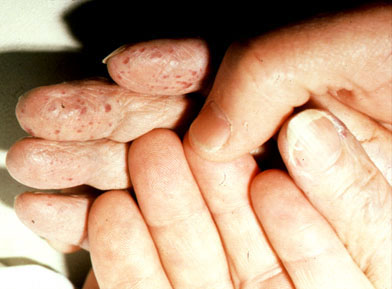 What causes the palms of hands to turn yellow or orange?
Carotenemia
Provided by: DrDonnica.com
Q: Recently I noticed that the palms of both my hands have turned a yellowish-orange color, like the color you'd get from a self-tanner.
The only problem is I'm not self-tanning. In fact, the only thing I'm doing differently is eating salad for lunch instead of fast food so I can squeeze into last summer's shorts. But shouldn't that make my skin rosier?
A: Are you sure you're just eating more salad?
One mistake many dieters make is to eat lots of baby carrots as though they are "free food." We like to snack on them because they're very tasty and healthy and we assume that if a little is good, a lot is better. But not only do carrots have a relatively high glycemic index, eating too many of them can cause the skin condition you described. This is called carotenemia and refers to the increased blood levels of carotene, the primary of Vitamin A.
The good news is that this condition is harmless and is not associated with increased levels of vitamin A. While carrots are the main source, carotene is found in all pigmented fruits and vegetables (especially squash, sweet potato, pumpkin, spinach, beans, corn and yams).
If your skin doesn't return to its normal color within four weeks of a lower carotene diet, consult your physician. While carotenemia is rare in other conditions, it has been found with hypothyroidism, diabetes mellitus, anorexia nervosa, liver disease, and renal disease. There is also a similar condition called lycopenemia, which causes an orange-red discoloration of the skin. This is a result of excessive intake of tomatoes and beets.
Friday, March 31, 2006
Genetic Counseling
If you and your partner are newly pregnant, you may be amazed at the number and variety of prenatal tests available to you. Blood tests, urine tests, monthly medical exams, diet questionnaires, and family history forms crowd your schedule and your desk, but each of these tests helps to assess the health of you and your baby - and to predict any potential health risks.
Unlike your parents, you may also have the option of genetic testing. These tests identify the likelihood of passing certain genetic diseases or disorders (those caused by a defect in the genes - the tiny, DNA-containing units of heredity that determine the characteristics and functioning of the entire body) to your children.
Some of the more familiar genetic disorders are:
Down syndrome
cystic fibrosis
sickle cell anemia
Tay-Sachs disease (a fatal disease affecting the central nervous system)
If your history suggests that genetic testing would be helpful, you may be referred to a genetic counselor. Or, you might decide to seek out genetic counseling yourself.
But what do genetic counselors do, and how can they help your family-to-be?
What Is Genetic Counseling?
Genetic counseling is the process of:
evaluating family history and medical records
ordering genetic tests
evaluating the results of this investigation
helping parents understand and reach decisions about what to do next
Genetic tests are done by analyzing small samples of blood or body tissues. They determine whether you, your partner, or your baby carry genes for certain inherited disorders.
Genes are made up of DNA molecules, which are the simplest building blocks of heredity. They're grouped together in specific patterns within a person's chromosomes, forming the unique "blueprint" for every physical and biological characteristic of that person.
Humans have 46 chromosomes, arranged in pairs in every living cell of our bodies. When the egg and sperm join at conception, half of each chromosomal pair is inherited from each parent. This newly formed combination of chromosomes then copies itself again and again during fetal growth and development, passing identical genetic information to each new cell in the growing fetus. Current science suggests that human chromosomes carry from 25,000 to 35,000 genes. An error in just one gene (and in some instances, even the alteration of a single piece of DNA) can sometimes be the cause for a serious medical condition.
Some diseases, such as Huntington's disease (a degenerative nerve disease) and Marfan syndrome (a connective tissue disorder), can be inherited from just one parent. Most disorders cannot occur unless both the mother and father pass along the gene. Some of these are cystic fibrosis, sickle cell anemia, and Tay-Sachs disease. Other genetic conditions, such as Down syndrome, are not inherited. In general, they result from an error (mutation) in the cell division process during conception or fetal development. Still others, such as achondroplasia (the most common form of dwarfism), may either be inherited or the result of a genetic mutation.
Genetic tests don't yield easy-to-understand results. They can reveal the presence, absence, or malformation of genes or chromosomes. Deciphering what these complex tests mean is where a genetic counselor comes in.
Who Are Genetic Counselors?Genetic counselors are professionals who have completed a master's program in medical genetics and counseling skills. They then pass a certification exam administered by the American Board of Genetic Counseling. Genetic counselors can help identify and interpret the risks of an inherited disorder, explain inheritance patterns, suggest testing, and lay out possible scenarios. (They refer you to a doctor or a laboratory for the actual tests.) They will explain the meaning of the medical science involved, provide support, and address any emotional issues often raised by the results of the genetic testing.
Who Should See One?Most couples planning a pregnancy or who are expecting don't need genetic counseling. About 3% of babies are born with birth defects each year, according to the U.S. Centers for Disease Control and Prevention - and of the malformations that do occur, the most common are also among the most treatable. Cleft palate and clubfoot, two of the more common birth defects, can be surgically repaired, as can many heart malformations.
The best time to seek genetic counseling is before becoming pregnant, when a counselor can help assess your risk factors. But even after you become pregnant, a meeting with a genetic counselor can still be helpful. For example, several babies have been diagnosed with spina bifida before birth. Recent research suggests that delivering a baby with spina bifida via cesarean section (avoiding the trauma of travel through the birth canal) can minimize damage to the baby's spine - and perhaps reduce the likelihood that the child will need a wheelchair. more...
and at www.dreddyclinic.com
Unlike your parents, you may also have the option of genetic testing. These tests identify the likelihood of passing certain genetic diseases or disorders (those caused by a defect in the genes - the tiny, DNA-containing units of heredity that determine the characteristics and functioning of the entire body) to your children.
Some of the more familiar genetic disorders are:
Down syndrome
cystic fibrosis
sickle cell anemia
Tay-Sachs disease (a fatal disease affecting the central nervous system)
If your history suggests that genetic testing would be helpful, you may be referred to a genetic counselor. Or, you might decide to seek out genetic counseling yourself.
But what do genetic counselors do, and how can they help your family-to-be?
What Is Genetic Counseling?
Genetic counseling is the process of:
evaluating family history and medical records
ordering genetic tests
evaluating the results of this investigation
helping parents understand and reach decisions about what to do next
Genetic tests are done by analyzing small samples of blood or body tissues. They determine whether you, your partner, or your baby carry genes for certain inherited disorders.
Genes are made up of DNA molecules, which are the simplest building blocks of heredity. They're grouped together in specific patterns within a person's chromosomes, forming the unique "blueprint" for every physical and biological characteristic of that person.
Humans have 46 chromosomes, arranged in pairs in every living cell of our bodies. When the egg and sperm join at conception, half of each chromosomal pair is inherited from each parent. This newly formed combination of chromosomes then copies itself again and again during fetal growth and development, passing identical genetic information to each new cell in the growing fetus. Current science suggests that human chromosomes carry from 25,000 to 35,000 genes. An error in just one gene (and in some instances, even the alteration of a single piece of DNA) can sometimes be the cause for a serious medical condition.
Some diseases, such as Huntington's disease (a degenerative nerve disease) and Marfan syndrome (a connective tissue disorder), can be inherited from just one parent. Most disorders cannot occur unless both the mother and father pass along the gene. Some of these are cystic fibrosis, sickle cell anemia, and Tay-Sachs disease. Other genetic conditions, such as Down syndrome, are not inherited. In general, they result from an error (mutation) in the cell division process during conception or fetal development. Still others, such as achondroplasia (the most common form of dwarfism), may either be inherited or the result of a genetic mutation.
Genetic tests don't yield easy-to-understand results. They can reveal the presence, absence, or malformation of genes or chromosomes. Deciphering what these complex tests mean is where a genetic counselor comes in.
Who Are Genetic Counselors?Genetic counselors are professionals who have completed a master's program in medical genetics and counseling skills. They then pass a certification exam administered by the American Board of Genetic Counseling. Genetic counselors can help identify and interpret the risks of an inherited disorder, explain inheritance patterns, suggest testing, and lay out possible scenarios. (They refer you to a doctor or a laboratory for the actual tests.) They will explain the meaning of the medical science involved, provide support, and address any emotional issues often raised by the results of the genetic testing.
Who Should See One?Most couples planning a pregnancy or who are expecting don't need genetic counseling. About 3% of babies are born with birth defects each year, according to the U.S. Centers for Disease Control and Prevention - and of the malformations that do occur, the most common are also among the most treatable. Cleft palate and clubfoot, two of the more common birth defects, can be surgically repaired, as can many heart malformations.
The best time to seek genetic counseling is before becoming pregnant, when a counselor can help assess your risk factors. But even after you become pregnant, a meeting with a genetic counselor can still be helpful. For example, several babies have been diagnosed with spina bifida before birth. Recent research suggests that delivering a baby with spina bifida via cesarean section (avoiding the trauma of travel through the birth canal) can minimize damage to the baby's spine - and perhaps reduce the likelihood that the child will need a wheelchair. more...
and at www.dreddyclinic.com
Wednesday, January 04, 2006
Ayurveda: Article
Ayurveda: Article: "By Parveen Chopra
The ancient Indian system, particularly its Kerala school; which is back in the reckoning after a brief hiatus, is as much concerned with promoting health and preventing disease as it is with curing ailments. Life Positive takes you to visit some flourishing practitioners and hospitals
It's like a brick kiln of hopes and desires, hot and claustrophobic. On this sticky August evening, there must be over a hundred people milling around in a small hall. Many have been stewing for hours, waiting for just a frenetic three-minute interview and pulse-reading by the good doctor. Hope here has neither class nor color nor gender; its' seekers include rich Gujarati businessmen and dirt poor, illiterate tribal women.
There are babies' squalls erupting out of this thicket and children running around. Somehow, amidst this mess, order finds its place: Queues�one to see the assistant doctors who prescribe diet, another for the dispensary, and so on.
Soon, like a DNA strand, a queue shuffles into existence in front of me, too. Ah, the doctor wants to show off. He is sending me patients who uniformly report remarkable recoveries from problems so varied and complex that few would believe something as gentle as ayurveda can handle: an athletic young man emotionally kayoed by a bout of impotence; a pale, skinny 25-year-old who bares, like a freak show artist, various parts of his anatomy to show me the scars of a lifetime of multiple diseases and complex treatments.
And one of the fattest people I have ever seen, a prosperous-looking safari-suit-clad man, claims he has sloughed off 100 pounds after he flew down for treatment about a month ago from England.
Welcome to Dr Pankaj Naram's clinic�rather one of his four clinics in one city alone: Mumbai,"
The ancient Indian system, particularly its Kerala school; which is back in the reckoning after a brief hiatus, is as much concerned with promoting health and preventing disease as it is with curing ailments. Life Positive takes you to visit some flourishing practitioners and hospitals
It's like a brick kiln of hopes and desires, hot and claustrophobic. On this sticky August evening, there must be over a hundred people milling around in a small hall. Many have been stewing for hours, waiting for just a frenetic three-minute interview and pulse-reading by the good doctor. Hope here has neither class nor color nor gender; its' seekers include rich Gujarati businessmen and dirt poor, illiterate tribal women.
There are babies' squalls erupting out of this thicket and children running around. Somehow, amidst this mess, order finds its place: Queues�one to see the assistant doctors who prescribe diet, another for the dispensary, and so on.
Soon, like a DNA strand, a queue shuffles into existence in front of me, too. Ah, the doctor wants to show off. He is sending me patients who uniformly report remarkable recoveries from problems so varied and complex that few would believe something as gentle as ayurveda can handle: an athletic young man emotionally kayoed by a bout of impotence; a pale, skinny 25-year-old who bares, like a freak show artist, various parts of his anatomy to show me the scars of a lifetime of multiple diseases and complex treatments.
And one of the fattest people I have ever seen, a prosperous-looking safari-suit-clad man, claims he has sloughed off 100 pounds after he flew down for treatment about a month ago from England.
Welcome to Dr Pankaj Naram's clinic�rather one of his four clinics in one city alone: Mumbai,"
Sunday, December 04, 2005
Baby Boomers, Elderly Exercise Metabolic Syndrome Away
Last year, I posted a news story about researchers studying the use of botox -- normally used to "cure" wrinkles -- as a method to treat migraines. I truly sympathize with people who suffer from the horrible pain associated with migraines. Sadly, desparate measures often provoke extreme risks, like injecting Botox and even incredibly insane things like having their facial muscles severed.
I thought it was sheer lunacy then. Can you imagine anything topping that? A recently completed U.S. study measured the merits of COMBINING BOTH botox and surgery to treat migraines?
No joke folks... Besides, April Fool's Day is still 13 weeks away!
Surprisingly, researchers injected about 100 patients with botox to find out which muscles triggered migraines, then used surgery to remove them. Even more astonishingly, surgery after the botox treatments reduced the intensity and frequency of migraines in 92 percent of patients and eliminated them altogether for a third of people involved.
The benefit as measured by the study wasn't recovery time or the lessening of pain. Merely, the potential to benefit employers and employees in terms of lost work time and productivity.
Again, it seems really insane to use a sanitized derivative of botulinum toxin Type A -- a bacterium found in contaminated food -- to treat patients for migraines much less surgery.
BBC News December 30, 2004
I thought it was sheer lunacy then. Can you imagine anything topping that? A recently completed U.S. study measured the merits of COMBINING BOTH botox and surgery to treat migraines?
No joke folks... Besides, April Fool's Day is still 13 weeks away!
Surprisingly, researchers injected about 100 patients with botox to find out which muscles triggered migraines, then used surgery to remove them. Even more astonishingly, surgery after the botox treatments reduced the intensity and frequency of migraines in 92 percent of patients and eliminated them altogether for a third of people involved.
The benefit as measured by the study wasn't recovery time or the lessening of pain. Merely, the potential to benefit employers and employees in terms of lost work time and productivity.
Again, it seems really insane to use a sanitized derivative of botulinum toxin Type A -- a bacterium found in contaminated food -- to treat patients for migraines much less surgery.
BBC News December 30, 2004
Sugar and Grains Increase Depression
 Baby Boomers, Elderly Exercise Metabolic Syndrome Away
I recently posted an article detailing some of the risks of metabolic syndrome, a deadly mix of several conditions -- weight gain, obesity, lack of physical activity and various genetic factors. As always, preventing weight gains and obesity is far easier than applying treatment options, though the success of prevention depends directly on the patient.
In a recent study of baby boomers and seniors (ages 55-75), even moderate exercise cuts the risk of developing a syndrome which increases heart disease and diabetes risk.
The group of more than 100 people, none of whom had shown any signs of cardiovascular disease (apart from slightly raised blood pressure), were monitored for six months. Half the participants took part in exercise sessions for an hour three times a week, including aerobic exercise and weightlifting, while the rest were given a booklet that encouraged increased activity, such as walking, to promote good health. (One caveat: At the beginning of the study, 41 percent of the participants had metabolic syndrome.)
By the end of the study, nine cases of metabolic syndrome were resolved and no new cases cropped up in the exercise group. In the control group, although eight participants no longer had the syndrome, four new cases appeared.
I was pleased by the results of the study, particularly the advice of one physician whose advice largely mirrors my own. "Our results show that this population can be motivated to follow through with a moderate exercise programm, and for some risk factors, such as abdominal fat, exercise can be as effective as what is accomplished today with drugs."
It's also important for you to think of exercise like a "drug." Needless to say, very few clinicians or patients understand this. In fact, exercise is one of the most powerful "drugs" that we have to treat type 2 diabetes. Unlike typical commercial drugs, exercise can actually cause one to go into permanent remission for diabetes.
There's plenty of information on my site that can help you jump-start an exercise program, particularly from experts in the field, contributing editors Paul Chek and Ben Lerner.
BBC News December 30, 2004
The Benefits of Chamomile Tea
You may recall an article I posted about the dangers of bisphenol A (BPA), an estrogen-like compound used to make common plastic food containers and baby bottles and to line tin cans. New research has found BPA stimulates the growth of a specific category of prostate cancer cell, potentially affecting the treatment efficacy for a subset of prostate cancers.
Specifically, the affected class of prostate cancer cell, characterized by mutated receptors for androgens (the male hormone), can proliferate in response to BPA.
Many cases of prostate cancer depend on androgens like testosterone for tumor growth and cancer cell proliferation, researchers said. A common treatment for prostate cancer includes limiting testosterone. However, patients with mutated androgen receptors may not respond to this therapy which is why exposure to BPA could potentially put them at higher risk for increased cancer cell growth.
And it's hard to get away from it too. More than 2.5 BILLION pounds of BPA are produced every year. That's why you should store your food and water in glass if at all possible. One of the easiest things you can do to cut back on your exposure: NEVER use Styrofoam cups, especially for hot drinks.
EurekAlert January 3, 2005
Specifically, the affected class of prostate cancer cell, characterized by mutated receptors for androgens (the male hormone), can proliferate in response to BPA.
Many cases of prostate cancer depend on androgens like testosterone for tumor growth and cancer cell proliferation, researchers said. A common treatment for prostate cancer includes limiting testosterone. However, patients with mutated androgen receptors may not respond to this therapy which is why exposure to BPA could potentially put them at higher risk for increased cancer cell growth.
And it's hard to get away from it too. More than 2.5 BILLION pounds of BPA are produced every year. That's why you should store your food and water in glass if at all possible. One of the easiest things you can do to cut back on your exposure: NEVER use Styrofoam cups, especially for hot drinks.
EurekAlert January 3, 2005
Subscribe to:
Posts (Atom)
Kamarani

